In those early moments, people aren't only evaluating your expertise—they're evaluating how your expertise is presented.
That's why financial services firm design in Toronto has become increasingly important. In a market as competitive as Bay Street and the Greater Toronto Area (GTA), your visual identity plays a significant role in communicating professionalism, stability, and trustworthiness long before a conversation begins.
For wealth management firms, financial advisors, accounting practices, and boutique investment firms, good design isn't about standing out through bold colours or creative trends. It's about creating confidence.
Every proposal, client presentation, market update, and website should reinforce the same message:
"This is a firm that is organized, experienced, and trustworthy."
The challenge is that many growing firms still rely on generic templates, disconnected marketing materials, or one-off design projects that fail to reflect the level of service they actually provide.
A professionally developed brand identity for financial services helps bridge that gap by ensuring every client touchpoint communicates the same level of professionalism your clients expect from the people managing their financial future.
Visual identity plays an important role in shaping how audiences perceive a company. Research from the Journal of Consumer Research has explored how brand signals influence consumer perception, decision-making, and trust formation.
Why Visual Credibility Matters More in Financial Services Than Almost Any Other Industry
Every industry depends on trust.
Financial services depend on trust before a client has experienced your service.
Unlike a restaurant where customers can read reviews or try a meal, financial advisory firms ask people to make decisions involving retirement savings, investment portfolios, estate planning, insurance, or long-term wealth management.
Those decisions carry significant emotional and financial weight.
Because of that, prospective clients pay close attention to subtle signals.
Your visual presentation becomes one of them.
A clean website communicates professionalism.
A polished proposal suggests attention to detail.
Consistent branding implies organizational discipline.
Well-designed market commentary reflects analytical thinking.
Individually, these elements may appear minor.
Together, they influence whether your firm feels established enough to manage someone's financial future.
For boutique firms competing against Canada's largest financial institutions, these signals become even more important.
Clients naturally compare every interaction against brands they've known for years.
Major banks and national wealth management firms have invested heavily in creating consistent, recognizable customer experiences.
Independent firms don't need to imitate those organizations.
They do, however, need to present themselves with the same level of professionalism.
If your firm's marketing materials feel disconnected or inconsistent, our guide on Why Does My Business Look Inconsistent? explains the common causes of fragmented branding and how businesses can create a stronger visual system.
What Bay Street Visual Credibility Actually Looks Like
When people think about premium design, they often imagine something creative or visually striking.
Financial services operate differently.
Credibility isn't built through visual complexity.
It's built through clarity.
Successful financial brands communicate confidence by removing unnecessary distractions.
You'll notice several characteristics shared by many respected firms operating throughout Bay Street and Toronto's Financial District:
structured page layouts
generous white space
disciplined typography
restrained colour palettes
consistent spacing
high-quality charts and diagrams
polished presentation documents
professional photography
minimal visual clutter
These choices are intentional.
Clients don't want financial information competing with decorative graphics.
They want information presented clearly and confidently.
That's why simplicity often communicates expertise more effectively than excessive creativity.
Good design supports the message rather than becoming the message.
The Difference Between Looking Professional and Looking Premium
Many financial firms already have professionally designed logos.
They may also have a modern website and business cards.
Yet their marketing still feels inconsistent.
That's because clients don't judge a brand by one asset.
They judge the complete experience.
A website may look polished while proposal templates still use outdated formatting.
LinkedIn graphics may rely on generic Canva layouts.
Presentation decks may use inconsistent fonts.
Fact sheets might have different margins, colour treatments, and typography than the firm's website.
None of these inconsistencies immediately destroy credibility.
Instead, they create subtle friction.
Clients may never consciously identify what's wrong.
They simply leave with the impression that the business feels less established than another firm they recently evaluated.
Consistency is often the difference between appearing competent and appearing premium.
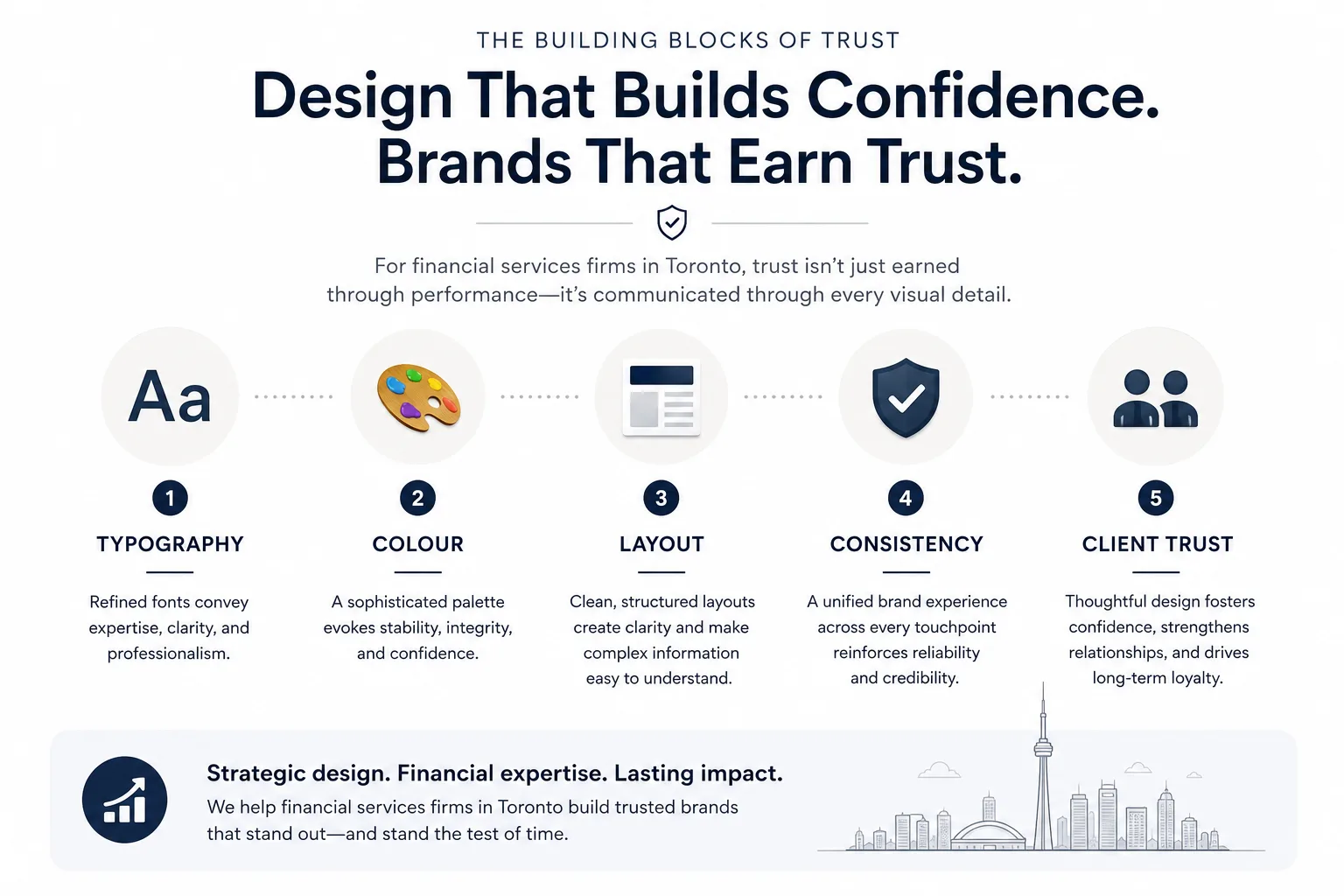
If you've noticed your firm's branding beginning to feel fragmented as your marketing grows, our article on Why Does My Business Look Inconsistent? explores the most common reasons visual identities become disconnected and practical ways to strengthen brand consistency across every customer touchpoint.
The Client-Facing Assets That Influence Trust the Most
Financial firms create far more than websites.
Every interaction contributes to a client's perception of your business.
Some assets carry significantly more influence than others.
Client Proposals
For many prospective clients, your proposal is the first detailed document they receive from your firm.
It should feel structured, refined, and easy to navigate.
Professional typography, consistent branding, and thoughtful layouts reinforce the quality of the advice inside.
Investment Commentary and Market Updates
Market commentary allows firms to demonstrate expertise while staying visible between client meetings.
However, complex financial information can quickly become overwhelming without clear visual hierarchy.
Well-designed reports improve readability, making charts, insights, and commentary easier to understand without sacrificing professionalism.
Pitch Decks
Whether you're presenting to prospective clients, referral partners, or business organizations, presentation quality matters.
A well-designed pitch deck doesn't simply organize information.
It reflects the quality of your thinking.
The visual polish of a presentation often shapes expectations before the first recommendation is ever discussed.
LinkedIn Content
LinkedIn has become one of the most important platforms for financial advisors building credibility.
Prospective clients frequently research advisors online before booking consultations.
Consistent graphics, branded market updates, educational content, and thought leadership all contribute to a stronger professional presence.
For firms investing in financial advisor marketing in Toronto, LinkedIn is no longer optional.
It's one of the most visible extensions of your brand.
Why Generic Templates Often Undermine Premium Positioning
Templates have their place.
They're useful for internal documents, quick drafts, and routine communication.
However, client-facing materials tell a different story.
Many widely used templates are instantly recognizable.
Prospective clients have seen the same layouts, icons, and design patterns used by dozens of businesses across multiple industries.
When every proposal begins to look familiar, it becomes harder for your firm to communicate its unique value.
Professional design isn't about making documents more decorative.
It's about making them feel intentionally created for your business.
That distinction becomes especially important in financial services, where attention to detail directly influences perceived credibility.
Rather than relying on generic templates, many firms now invest in custom design systems that ensure proposals, presentations, reports, social media graphics, and marketing materials all communicate the same level of professionalism.
A consistent visual system doesn't simply make your brand look better.
It helps clients feel more confident in the expertise behind it.
The Typography and Colour Standards That Signal Financial Credibility
In financial services, design choices communicate before words are read.
A client may not consciously analyze why a proposal feels trustworthy, but they immediately experience the signals created by typography, spacing, colour, and layout.
The strongest financial brands understand that visual decisions are not simply aesthetic preferences.
They are communication tools.
For firms operating in Toronto's competitive financial market, every design element should reinforce qualities clients are looking for:
stability
expertise
precision
trust
professionalism
This is why financial services branding tends to follow a more refined visual language than industries where creativity and experimentation are the primary goals.
Why Typography Matters in Wealth Management Branding
Typography is one of the most underestimated elements of financial branding.
The fonts a firm chooses influence how information feels.
Traditional serif typefaces are often associated with:
heritage
authority
reliability
established expertise
This is why many financial institutions, law firms, and advisory companies incorporate serif typography into their brand systems.
Serifs carry historical associations with printed publications, established institutions, and industries where credibility has been built over decades.
However, modern financial brands often balance this tradition with clean sans-serif typography.
The result is a visual system that communicates both:
experience and stability
accessibility and modern thinking
For example, a boutique wealth management firm serving high-net-worth clients may want to communicate trust and legacy, while a technology-focused investment advisory firm may want to communicate innovation and forward thinking.
The right typography depends on the firm's positioning.
There is no universal "financial services font."
There is only typography that aligns with the audience, service offering, and brand personality.
Why Colour Choices Matter for Financial Services Firms
Colour is another important trust signal.
In Toronto's financial sector, successful brands often use restrained colour palettes because they communicate confidence rather than urgency.
Common choices include:
navy
charcoal
deep green
warm neutrals
muted blues
subtle accent colours
These colours are often associated with:
professionalism
stability
security
sophistication
That doesn't mean financial firms cannot use colour creatively.
It means creativity should support credibility.
A financial advisor helping clients plan retirement investments has a different communication challenge than a consumer brand trying to attract attention online.
The visual goal is not to create excitement.
The goal is to create confidence.
This is where experienced Toronto design studios bring value. They understand that design decisions should support business positioning, not simply follow trends.
The Compliance-Adjacent Design Challenge
Financial services firms operate within a unique environment.
Unlike many industries, marketing materials often need to balance two priorities:
Looking professional and memorable.
Communicating information clearly and responsibly.
Client-facing materials must often include disclosures, financial information, performance data, risk statements, and regulatory requirements.
This creates a design challenge.
Poorly designed materials may technically include everything required, but they can overwhelm readers.
Too much text.
Too little hierarchy.
Unclear sections.
Difficult-to-read charts.
A strong designer understands that compliance requirements are not obstacles.
They are design constraints.
The goal is to organize complex information so clients can understand it easily while maintaining a professional appearance.
This is especially important for:
investment reports
client onboarding documents
wealth planning presentations
educational resources
market commentary
The best financial materials make complex information feel approachable without oversimplifying it.
Clear communication is especially important in financial services, where complex information needs to be presented responsibly. The Financial Consumer Agency of Canada provides resources focused on helping Canadians better understand financial information and make informed decisions.
Why Compliance Can Become a Competitive Advantage
Many smaller financial firms meet compliance requirements but stop there.
Their materials are functional.
However, they often fail to create a premium experience.
This creates an opportunity.
A boutique advisory firm that produces clear, professionally designed, compliance-conscious materials immediately separates itself from firms that rely on basic templates.
The difference is noticeable.
Imagine two firms providing the same financial recommendation.
One sends a document that feels outdated, crowded, and difficult to navigate.
The other provides a carefully designed presentation with clear sections, professional charts, consistent branding, and thoughtful information hierarchy.
The advice may be identical.
The perceived experience is not.
In a trust-based industry, the quality of the experience influences how clients perceive the quality of the service.
According to the Investment Industry Regulatory Organization of Canada (IIROC) guidance on client communication principles, firms must ensure communications are fair, balanced, and not misleading—making clarity and responsible presentation essential when creating client-facing materials.
Canadian Investment Regulatory Organization (CIRO)
Good design supports this goal by helping firms communicate complex information more clearly.
Why Financial Firms Need More Than a Graphic Designer
A financial services firm doesn't just need someone who can make attractive graphics.
It needs someone who understands the purpose behind those graphics.
A LinkedIn post for a wealth advisor is not simply a social media image.
It is a credibility-building tool.
A client presentation is not simply a collection of slides.
It is a reflection of the firm's professionalism.
A market update is not simply a document.
It is an opportunity to demonstrate expertise.
This distinction is why many firms move away from transactional design relationships and toward ongoing creative partnerships.
A designer who understands your firm's positioning can make stronger decisions because they know:
who your clients are
how your firm differentiates itself
what tone your communication requires
what level of sophistication your audience expects
Why a Dedicated Design Partner Works Better for Financial Services Firms
Financial services firms often have recurring creative needs.
New market reports.
Updated presentations.
Client education materials.
LinkedIn content.
Event materials.
Website updates.
Seasonal campaigns.
Managing each project separately creates unnecessary friction.
A dedicated design partner creates continuity.
Instead of briefing a different designer every time, your creative partner becomes familiar with your firm's standards and expectations.
Over time, this creates several advantages:
Faster Turnaround
Less time is spent explaining requirements because the designer already understands your brand.
Stronger Consistency
Every asset follows the same visual system.
Better Strategic Input
The designer can suggest improvements based on previous work and business goals.
Easier Scaling
As marketing needs increase, your firm has reliable creative support available.
This is why many growing financial firms explore a Design Retainer model rather than relying entirely on one-off projects.
Why Local Experience Matters for Toronto Financial Firms
A financial firm in Toronto does not operate in a vacuum.
Your clients compare you against other firms in your region.
They see the websites, presentations, and marketing materials of competitors.
They attend industry events.
They interact with financial brands every day.
A designer familiar with the GTA understands these market expectations.
They understand the difference between:
a traditional Bay Street investment firm
a modern independent wealth advisor
a boutique financial planning practice
a growing advisory firm targeting younger professionals
Each requires a different visual strategy.
The goal is not to copy competitors.
The goal is to understand the market well enough to create a brand that feels credible while still being distinctive.
This is where working with a local partner provides an advantage.
Choosing the Right Design Partner for Your Financial Firm
The right creative partner should understand that financial design is about more than aesthetics.
When evaluating a designer or studio, consider:
Do they understand professional service industries?
Can they explain their strategic approach?
Do they create systems rather than individual graphics?
Do they understand your audience?
Do they prioritize consistency?
Can they support ongoing needs?
A strong partner should feel like an extension of your marketing team.
They should help your firm communicate expertise with clarity and confidence.
For financial services businesses, the objective is not to look the most creative.
It is to look the most trustworthy, capable, and prepared.
That is what effective financial services design achieves.
Building a Financial Brand That Matches the Quality of Your Advice
For financial services firms, reputation is built over time.
Every client interaction contributes to how people perceive your expertise, reliability, and professionalism. While experience, credentials, and results remain the foundation of trust, your visual presentation influences whether potential clients feel confident enough to begin that relationship.
A firm that provides exceptional financial advice but presents itself through inconsistent, outdated, or generic materials creates unnecessary doubt.
On the other hand, a firm with a cohesive visual identity communicates something powerful before a conversation even begins:
"We pay attention to details."
For wealth managers, financial advisors, and boutique investment firms in Toronto, design is not about following trends or creating flashy marketing.
It is about creating a consistent experience that reflects the quality of the service behind the brand.
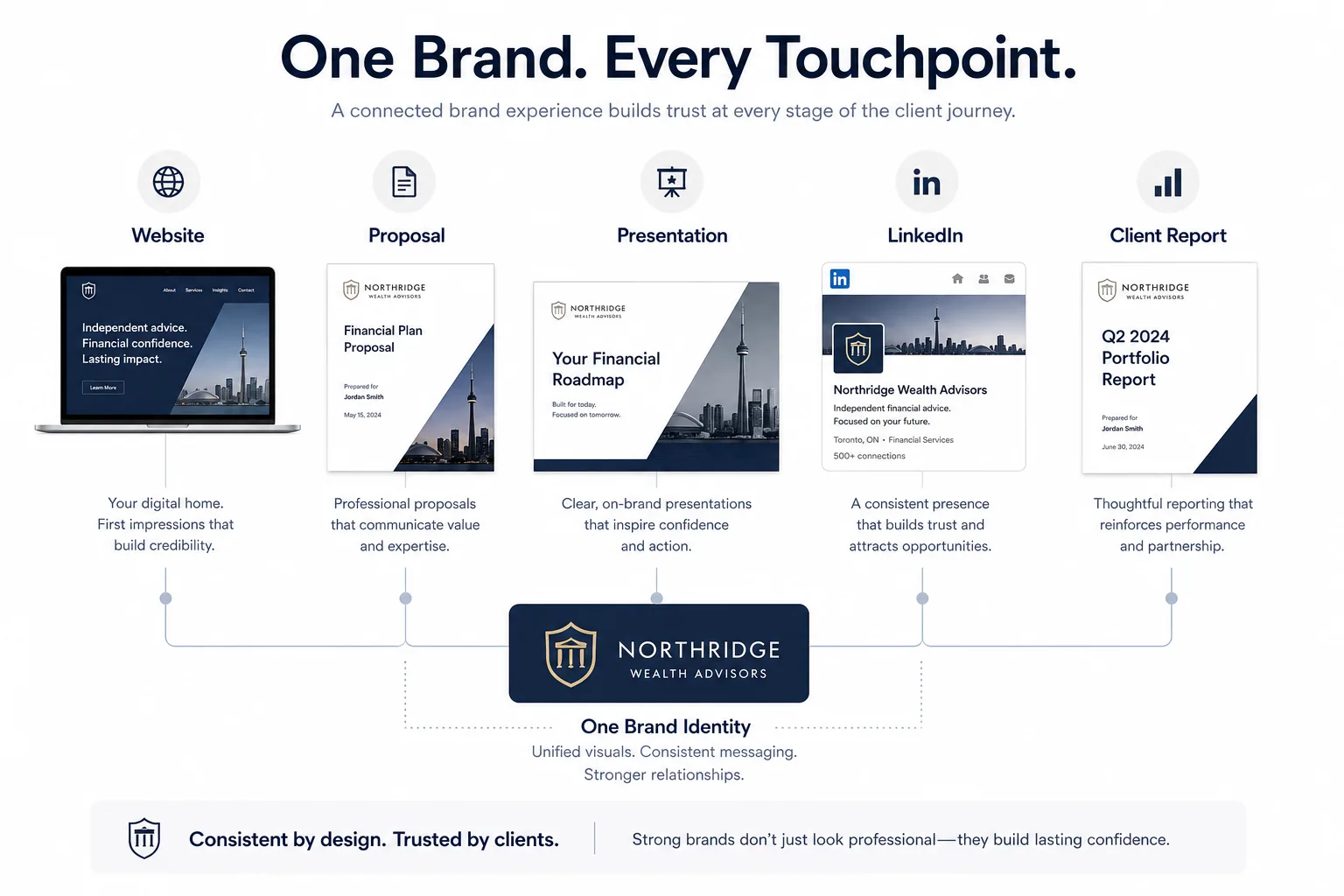
A professional visual system ensures your website, proposals, presentations, LinkedIn presence, reports, and client communications all feel connected.
This consistency creates familiarity.
Familiarity builds confidence.
And confidence is one of the most valuable assets a financial services firm can develop.
Why Growing Financial Firms Are Investing in Ongoing Design Support
Many financial firms begin with occasional design projects.
A new website.
A refreshed presentation deck.
A few marketing templates.
At an early stage, this approach may work.
However, as firms grow, their communication needs increase.
More advisors join the team.
More content is published.
More client materials are created.
More opportunities appear to demonstrate expertise.
Eventually, design becomes an ongoing business function rather than an occasional requirement.
This is where a long-term creative partnership becomes valuable.
A dedicated design partner can help maintain consistency while supporting new opportunities as they arise.
Instead of asking:
"Who can design this quickly?"
firms can begin asking:
"How can we communicate our expertise more effectively?"
That shift changes design from a production task into a strategic business asset.
For financial firms competing in Toronto's premium market, this difference matters.
For firms considering ongoing creative support, understanding investment expectations is an important first step. Our guide on Monthly Design Retainer Cost Toronto explains what factors influence pricing and what businesses should consider when choosing a design partnership.
The Future of Financial Services Branding in Toronto
The financial services landscape continues to evolve.
Clients today expect more transparency, more education, and more digital engagement from the firms they trust.
Financial advisors are no longer competing only through referrals and traditional relationships.
They are also competing through:
websites
LinkedIn thought leadership
educational content
digital presentations
online resources
client experiences
This means visual communication will continue becoming more important.
The firms that stand out will not necessarily be the loudest.
They will be the ones that consistently communicate expertise, professionalism, and trust across every channel.
For Toronto financial firms, investing in thoughtful design is not simply about improving appearance.
It is about creating a stronger foundation for growth.
Frequently Asked Questions
What makes financial services firm design different from other industries?
Financial services design requires a careful balance between professionalism, trust, clarity, and compliance. Unlike consumer industries where brands may focus on excitement or emotional appeal, financial firms need visuals that communicate stability, expertise, and confidence.
Why does a financial services firm in Toronto need professional branding?
Toronto's financial market is highly competitive. Clients often compare multiple advisors, wealth managers, and investment firms before making decisions. Professional branding helps firms create a stronger first impression and communicate credibility across websites, presentations, proposals, and marketing materials.
What should financial advisors include in their visual branding?
A strong financial advisor brand should include:
consistent typography
defined colour guidelines
professional presentation templates
branded social media graphics
client document systems
website visuals
marketing collateral
These elements create a consistent experience across every client interaction.
How can design help financial advisors attract more clients in Toronto?
Effective design supports financial advisor marketing in Toronto by helping advisors communicate expertise online. Consistent LinkedIn graphics, educational content, presentations, and branded resources can strengthen credibility and make it easier for potential clients to understand the firm's value.
What is wealth management branding?
Wealth management branding is the process of creating a visual and strategic identity that communicates a firm's values, expertise, and approach to managing client relationships. It includes brand identity, messaging, website design, marketing materials, and client-facing experiences.
Should financial firms use templates or custom design?
Templates can be useful for internal materials or quick updates. However, firms competing in premium markets often benefit from custom design systems because they provide greater consistency, differentiation, and alignment with the firm's positioning.
How often should a financial services firm update its branding?
Most firms do not need to completely redesign their brand frequently. Instead, they should regularly review whether their visual identity still reflects their market position, audience expectations, and business growth. Small improvements over time often create stronger results than frequent complete redesigns.
What does a financial services design retainer include?
A design retainer provides ongoing creative support instead of individual project-based work. Depending on the partnership, it may include:
presentation design
social media graphics
marketing materials
document templates
website updates
brand consistency support
This approach allows financial firms to access reliable creative support without hiring a full-time designer.
How do I choose a Toronto design studio for my financial firm?
Look for a studio that understands professional services, has experience creating strategic brand systems, communicates clearly, and can support ongoing marketing needs.
The best partner should understand both design and business strategy—not just how to make something visually appealing.
Build a visual identity that reflects the expertise behind your financial services firm.
Get in touchPixie Creative is a Toronto-based monthly design partner for GTA professional services firms — including law firms, consulting businesses, and financial services companies. Founded by Maryam, Pixie Creative provides dedicated design support without the freelancer chaos or subscription queue overhead.