If you've started searching for design support for your Toronto business, you've already discovered that pricing makes very little sense. A logo on Fiverr runs $50. A branding agency quotes $25,000. A freelancer sends you a rate card showing $85 to $150 an hour. And none of those numbers come with much explanation of what you'd actually be getting.
For founders, marketing managers, and boutique firm principals operating in the GTA, none of those options are quite right because none of them were designed for how a growing, premium business actually needs graphic design to work. This post breaks down what professional graphic design support genuinely costs in Toronto in 2026, explains what you're paying for at each price point, and helps you figure out which model your business has outgrown.
First: What Is a Monthly Design Retainer, Exactly?
A monthly design retainer, sometimes called a design partnership or a fractional designer arrangement, is an ongoing engagement where you pay a flat monthly fee to retain a graphic designer's availability, attention, and accumulated knowledge of your brand. You're not buying a single logo or a one-off pitch deck. You're embedding a designer into your marketing operation for a sustained period, so they learn your visual standards, your clients, your communication style, and your upcoming needs.
The distinction matters. A project-based relationship resets every time. A retainer compound. By month three, a good design partner needs a three-line message to produce something pitch-perfect, because they already know the rest.
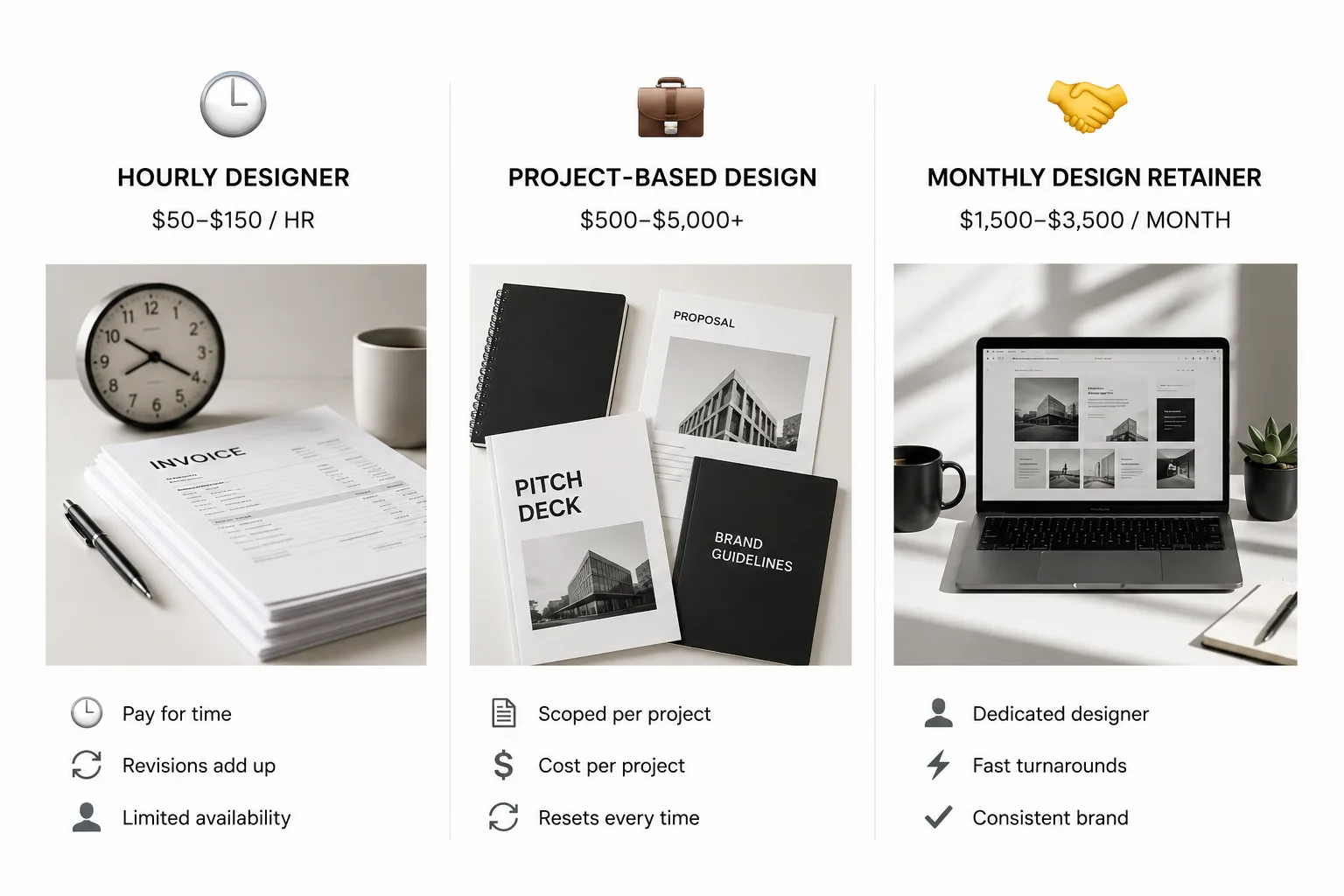
Hourly Rate Graphic Design: $50–$150/Hour
Toronto freelance graphic designers typically charge between $50 and $150 per hour depending on their experience, specialisation, and how in-demand they are. It sounds straightforward. It isn't.
The first problem is how the billing model works.
You're paying for time, not outcomes. Every revision is another line on the invoice. For any business where brand precision actually matters, where a pitch deck going to a serious prospect needs to be exactly right, revisions are the norm. You pay for the first attempt and then pay again for the corrections.
The second problem is knowledge.
An hourly freelancer operates at arm's length from your business. They don't know your clients, your visual standards, or the fact that you always go charcoal, never black. Every hour they bill includes time spent learning what you want, time you're funding but receiving no direct value from.
The third problem is availability.
Good Toronto graphic designers charge $85–$150 an hour precisely because they're in demand. When you need something urgently; before a pitch, a conference, an executive meeting next Tuesday, your freelancer may not have a slot. You either wait, or you find someone faster and cheaper who doesn't know your brand. Neither outcome serves a premium firm.
The hourly model optimises for the designer's interests, not yours. They get paid regardless of whether the first attempt lands correctly, and their calendar is always the bottleneck on your most important deadlines.
Project-Based Graphic Design: $500–$5,000+ Per Project
Most freelancers and studios default to project-based pricing because it's easier to scope and estimate. The numbers in Toronto look roughly like this: a LinkedIn graphic runs $200–$400, a pitch deck is $800–$2,500, and a full capabilities document or capability statement lands between $1,500 and $4,000, depending on complexity and the designer's market position.
For businesses with genuinely occasional design needs, a logo refresh once every couple of years, a single annual report, or project-based work makes reasonable sense. The work is scoped, the fee is agreed, and everyone moves on.
For premium boutiques and professional services firms in the GTA, it rarely stays that clean. Most firms producing regular marketing materials like LinkedIn content, proposal updates, pitch decks, event assets, and one-pagers for new service lines are placing four to twelve graphic design projects a year. At that volume, project-based becomes the most expensive and most exhausting way to get things done.
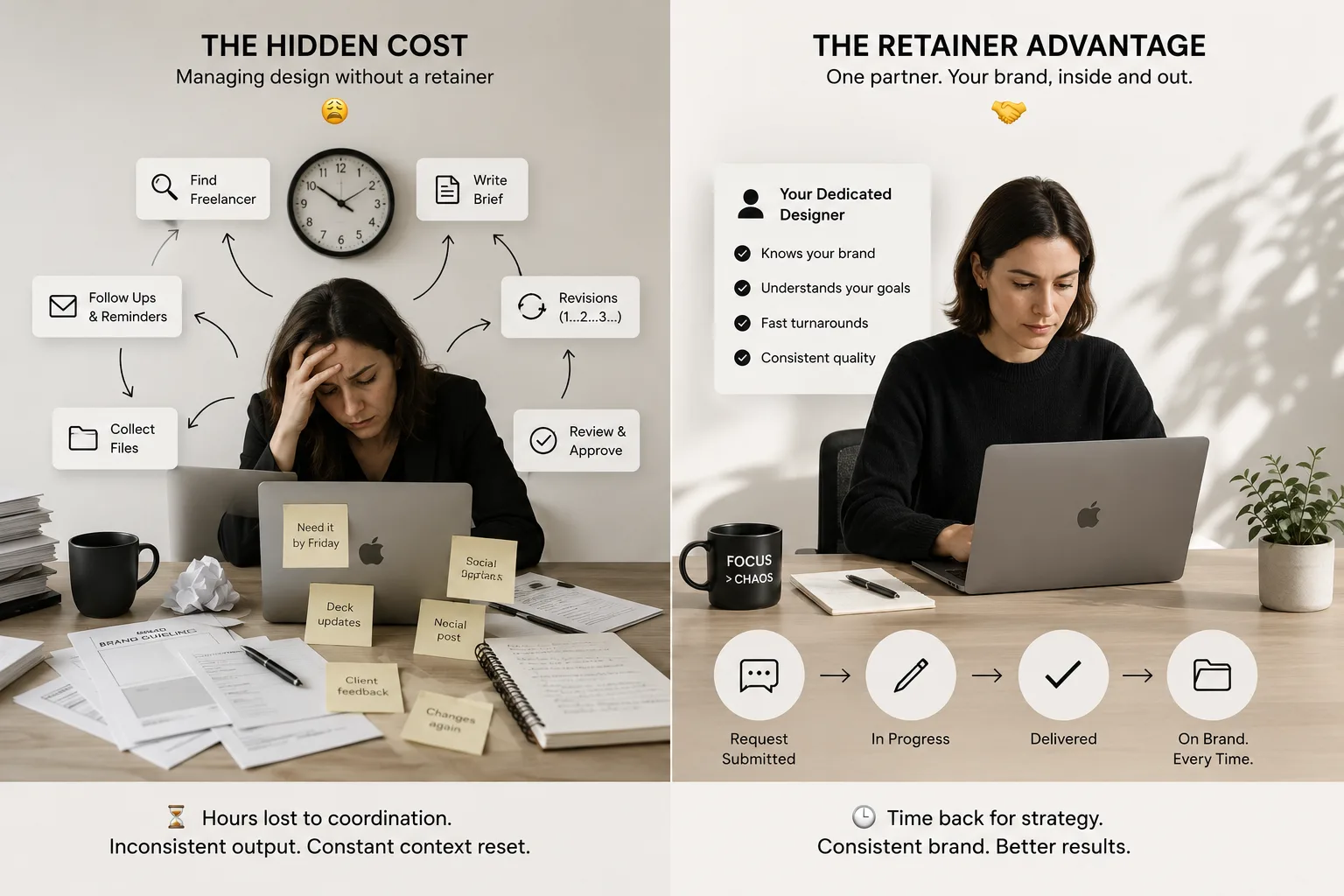
The hidden cost that never appears on an invoice is the management overhead you absorb on every project cycle: writing a brief, onboarding the designer, managing the timeline, handling multiple rounds of revision, approving file deliveries, and storing assets properly. Multiply that by ten or twelve projects a year, and you've spent a material number of senior leadership hours on creative administration time a marketing manager or founder should genuinely never be spending. ccording to research published by Nielsen Norman Group on design operations maturity, organisations without a systematic design engagement model spend disproportionate time on coordination rather than strategy, regardless of team size. That invisible overhead, added on top of the visible project fees, makes the project model far more expensive than the invoices suggest.
The hidden cost of project-based design is the management overhead that never gets priced in. For every project, you or your marketing manager must write a brief, onboard the designer, manage the timeline, review multiple iterations, and handle file delivery. Multiply that by twelve projects a year and you've spent a meaningful number of hours on creative administration alone, time that a senior marketing manager or founder should never be spending. According to Clutch's research on SMB design spending, the majority of small and mid-size businesses cite inconsistent output and poor communication as their top frustrations with freelance graphic designers — ahead of cost. That invisible overhead, added to the visible project fees, makes the project model far more expensive than the invoices suggest.
Monthly Design Retainer / Design Partnership: $1,500–$3,500/Month
The monthly model is structurally different from either of the above. Instead of paying per hour or per project, you retain a graphic designer's ongoing availability and embed them in your business. Over time, they accumulate brand knowledge that changes the economics of every subsequent request.
In Toronto, monthly design retainers for professional services firms and growth-stage businesses typically run $1,500 to $3,500 per month depending on output volume, scope, and seniority. Pixie Creative's partnership tiers sit at $1,500, $2,500, and $3,500 per month, with each tier structured around how much graphic design output your team is actually producing each month, rather than arbitrary hour counts.
What does that actually buy you?
One graphic designer who knows your brand without being briefed from scratch. Turnarounds of 24–48 hours on active requests. Consistent visual output across every touchpoint; proposals, social media, presentations, one-pagers, newsletters, that looks like it came from the same company because it did.
The economics only make sense when you calculate total cost of ownership, not just the monthly fee. Most GTA businesses that switch to a monthly design partnership find that leadership time savings alone justify the investment before they even account for the improvement in brand consistency. When you add the reclaimed time to the improved output quality, the retainer doesn't represent added cost; it replaces a more expensive and far less efficient arrangement.
So What Does a Monthly Design Retainer Include?
This is the question most people have after the sticker shock of the first number wears off. What, concretely, are you getting?
With a well-structured monthly graphic design partnership in the GTA, you should expect: a dedicated designer assigned to your account (not a rotating pool of strangers), a defined number of active design requests at any given time, documented brand knowledge that eliminates the briefing overhead after the first few months, fast turnarounds on active requests, and a flat monthly fee that replaces every ad-hoc invoice.
What you're not getting is unlimited throughput. The monthly model has a defined scope, and it's designed around what a real business with real design needs actually produces each month — not a theoretical maximum. If your needs are irregular and truly occasional, the model doesn't fit.
How Do You Know Which Model Is Right for Your Business?
Ask yourself a direct question: how much time do you or your marketing manager spend each week thinking about, managing, briefing, or chasing graphic design?
If it's less than two hours a week and genuinely occasional, project-based probably still works for you.
If it's three or more hours a week tracking down freelancers, revising briefs, reviewing iterations, chasing file deliveries, and wondering why the LinkedIn post looks nothing like the pitch deck, you are already paying for the monthly model. You're just paying in leadership hours instead of a flat fee. The retainer doesn't add a design cost to your business; it converts an existing, untracked, unoptimised cost into something predictable, consistent, and handled.
The clearest signal that it's time to move: your brand has started to look inconsistent across touchpoints. Your website, proposals, and social media look like they came from three different companies. A prospect or referral notices before you do. That's not a design problem. That's a model problem.
What About Design Subscription Services?
Design subscription services, broadly, platforms where you pay a monthly fee and submit requests to a team of rotating designers, exist at a lower price point, typically $500–$1,000 per month. They solve the billing predictability problem but don't solve the knowledge problem.
With a subscription service, you're still briefing from scratch on every request, because the designer handling your work this week almost certainly didn't handle last week's. Output quality varies. Brand consistency requires you to manage it yourself, which means the management overhead doesn't disappear — it just changes shape.
A true monthly design partnership, like what Pixie Creative's graphic design services offer, is a different product: one designer, ongoing, who accumulates your brand knowledge over time and operates as a fractional member of your marketing function.
The Real Cost Comparison
To make this concrete: imagine a Toronto marketing manager at a mid-market professional services firm. She places approximately ten graphic design projects per year. Each project averages $1,200 in freelancer fees. That's $12,000 annually in visible design spend.
Now add the invisible spend. Ten project cycles, each requiring roughly three hours of her time for briefing, management, and review. That's thirty hours per year at a conservative $75/hour fully loaded cost $2,250 in leadership time on creative administration alone. Total real cost: approximately $14,250 per year, for inconsistent output from rotating designers who never quite know the brand.
Against that, a $1,500/month retainer with a dedicated designer costs $18,000 annually. The gap is $3,750 paid back in full within two months of reclaimed leadership time, before accounting for better output, faster turnarounds, or the brand equity compounding effect of consistent graphic design across every client touchpoint.
The Question Worth Sitting With
The graphic design pricing conversation in Toronto usually starts with "how much does this cost?" That's the wrong question. The right question is: what is inconsistent, under-managed, ad-hoc design costing your business right now in time, in credibility, and in the gap between how good your business is and how good it looks?
If you're a GTA founder or marketing manager who's started asking that question, the monthly design partnership model almost always answers it.
Pixie Creative is a Toronto-based monthly graphic design partner for professional services firms, boutiques, and scaling businesses across the GTA. See how the partnership works or explore our graphic design services.
Get in touchPixie Creative is a Toronto-based monthly design partner for GTA professional services firms — including law firms, consulting businesses, and financial services companies. Founded by Maryam, Pixie Creative provides dedicated design support without the freelancer chaos or subscription queue overhead.