What is an hour of my time actually worth?
It's easy to answer when you're billing clients.
It's much harder when those hours disappear into internal work that never appears on an invoice.
For founders, marketing managers, business development leaders, and COOs at growing businesses across Toronto and the GTA, one of the biggest consumers of high-value time isn't sales, strategy, or client work.
It's design management.
Not necessarily designing graphics yourself—although many founders still do—but reviewing drafts, writing creative briefs, searching for brand assets, requesting revisions, answering designer questions, updating presentations, and making last-minute marketing fixes before an important meeting.
Individually, these tasks feel insignificant.
Collectively, they consume dozens of leadership hours every quarter.
The challenge is that these hours rarely appear on a financial report.
Instead, they quietly reduce the amount of time available for activities that actually grow the business.
If your leadership team spends even a few hours each week managing creative work, the real cost of design is likely much higher than what you're paying a freelancer or agency.
This is why every growing business should conduct a simple founder time cost design Toronto audit.
Not because design is expensive.
Because leadership time is.
Why leadership time is your most valuable business asset
As businesses grow, founders naturally begin delegating work.
Bookkeeping gets outsourced.
Payroll moves to specialists.
IT support becomes managed.
Legal work goes to lawyers.
The reason is simple.
Your time becomes increasingly valuable.
Every hour spent on work someone else could do is an hour not spent on work only you can do.
Design often escapes this calculation.
Unlike accounting or legal work, design management feels manageable.
A quick revision here.
A presentation update there.
An email explaining feedback.
Twenty minutes finding the latest logo.
Another fifteen reviewing social media graphics.
None of these tasks seem particularly significant.
Until you add them together.
Many Toronto businesses unintentionally treat design as "small work" because each task is relatively short.
But operational costs rarely come from individual tasks.
They come from repetition.
A ten-minute interruption repeated fifty times over a month becomes more expensive than a single half-day meeting.
The same principle applies to design.
If this pattern feels familiar, our article The Founder's Bottleneck: Why Managing Your Own Design Is Costing Your GTA Business More Than You Think explores why creative management often becomes one of the biggest hidden growth constraints for founders.
The design time audit every GTA business leader should run
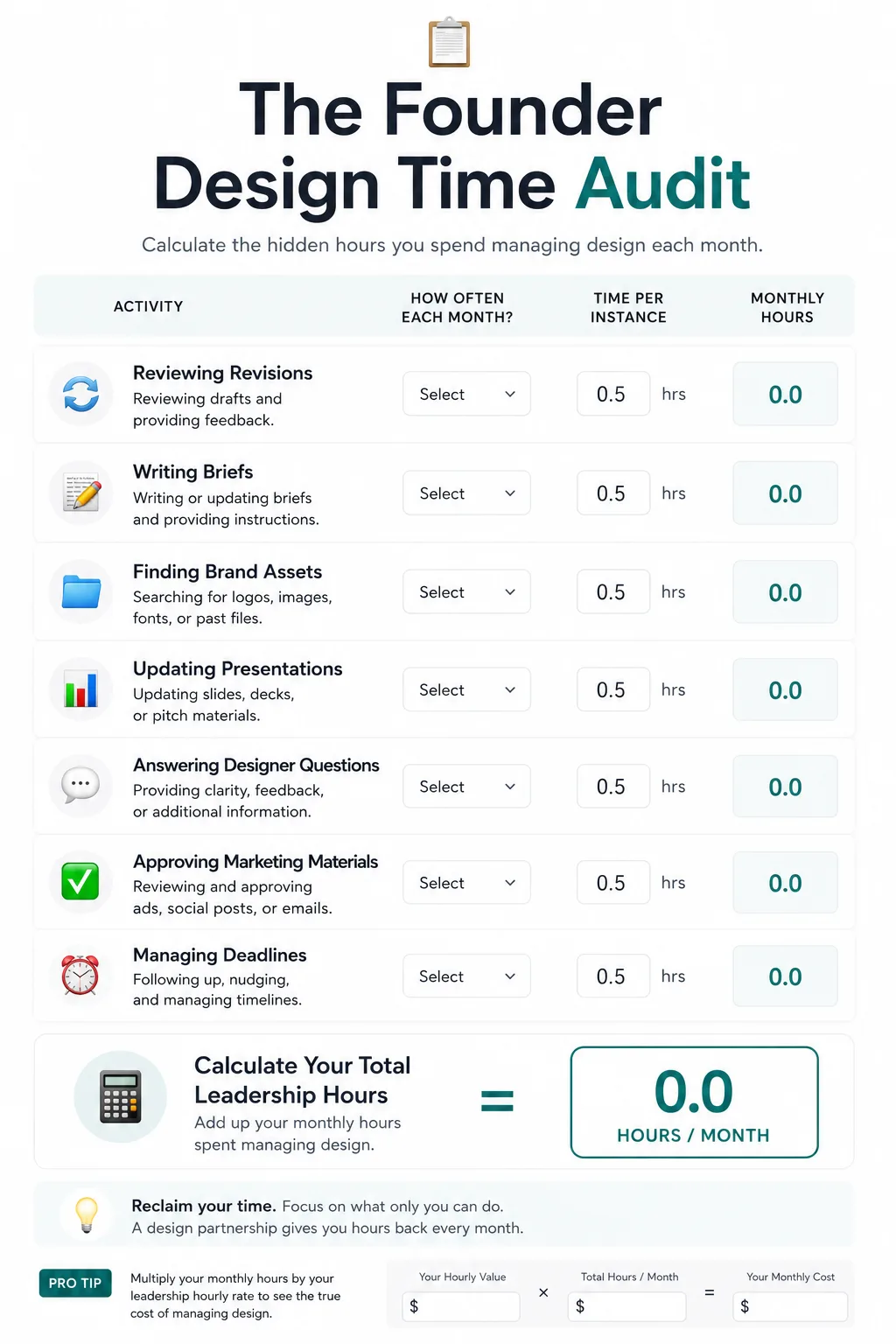
Before deciding whether your current creative process is working, spend fifteen minutes reviewing your calendar from the past thirty days.
Count every hour you spent on design-related activities—not creating strategy, but managing creative execution.
That includes activities such as:
Reviewing or revising freelancer work
Writing creative briefs
Searching for logos or brand files
Updating proposal decks
Formatting PowerPoint presentations
Building Canva graphics
Scheduling or posting social media
Explaining design changes over email
Following up on overdue deliverables
Collecting stakeholder feedback
Organizing brand assets
Preparing files for print
Checking typography or spacing before sending client-facing documents
Many founders underestimate these tasks because they happen in small increments.
Five minutes here.
Ten minutes there.
Twenty minutes before a meeting.
Half an hour before a proposal deadline.
By the end of the month, those small interruptions have quietly accumulated into several working days.
A simple monthly audit
Ask yourself:
How many design requests did I personally manage?
How many revisions did I review?
How many emails were exchanged about creative work?
How many presentations did I edit myself?
How many times did I search for logos, images, or previous files?
How often did I postpone higher-value work because marketing materials weren't ready?
Then total the time.
Most growing businesses are surprised by the answer.
For professional service firms across Toronto, it's common to find somewhere between four and ten hours every month devoted purely to creative administration.
That's before considering the actual production work completed by a freelancer or agency.
The hidden cost isn't design—it's opportunity cost
Imagine two founders.
Founder A spends six hours every month coordinating design work.
Founder B spends those same six hours meeting prospective clients, improving service delivery, or strengthening referral partnerships.
Both businesses pay roughly the same amount for design.
Only one founder has six additional hours invested in business growth.
That's the real difference.
Leadership time has an opportunity cost.
Every hour spent managing design is an hour unavailable for activities that directly influence revenue, client relationships, hiring, or long-term strategy.
This is especially true for firms where senior leaders remain heavily involved in business development.
Whether you're a consultant in Yorkville, a financial advisor in Toronto's Financial District, or a managing partner at a law firm in Vaughan, your calendar is already full.
Adding creative project management to that schedule rarely creates value.
It simply shifts your attention away from work that only leadership can perform.
Calculating your actual cost
The audit itself is remarkably simple.
Multiply:
Leadership hours spent managing design × your effective hourly value
For example:
A founder whose time is worth $350 per hour spends approximately six hours each month managing design requests.
The calculation looks like this:
6 hours × $350 = $2,100
That $2,100 never appears as a design invoice.
Instead, it's hidden inside your calendar.
You still pay your freelancer.
You still invest in software.
You still spend time reviewing revisions.
The true monthly cost of design becomes significantly higher than most businesses realize because leadership time is often excluded from the calculation.
And yet, from a business perspective, it may be the most expensive part of the entire workflow.
Design isn't just another operational expense
This realization changes how businesses evaluate creative support.
Many leaders ask:
"Can we justify spending $1,500 per month on a design retainer?"
A more useful question is:
"How much are we already spending without realizing it?"
Once leadership time is included alongside freelancer fees, software subscriptions, revision cycles, and project management, the comparison often looks very different.
Instead of comparing a retainer against a freelancer's invoice, you're comparing it against the total cost of your current system.
That's a much more accurate business decision.
The comparison that changes the conversation
Once you've completed your design time audit, the next step isn't to ask whether a monthly design partnership is affordable.
It's to compare it against what your current process is already costing.
This is where many founders have their "aha" moment.
At first glance, a monthly design retainer might appear to be an additional business expense.
But after accounting for leadership time, the conversation changes entirely.
Imagine your audit reveals the following:
Leadership time managing design: $2,100
Freelancer invoices: $900
Design software and subscriptions: $150
Your total monthly design system is already costing approximately $3,150.
Now compare that with a dedicated monthly design partnership.
Instead of paying separately for production, management, revisions, and your own lost leadership time, you're investing in a system designed to reduce those hidden costs from the outset.
The question is no longer:
"Can we afford ongoing design support?"
The better question becomes:
"Why are we paying more for a process that requires more work from our leadership team?"
It's not an additional expense—it's a reallocation
This distinction is one of the most important ideas in this entire discussion.
Businesses often evaluate design retainers through an accounting lens.
"We're adding another monthly subscription."
That framing misses the bigger picture.
You're not adding work.
You're moving work.
Instead of founders and marketing managers spending valuable hours managing creative execution, those responsibilities shift to someone whose expertise is design.
The investment isn't simply purchasing graphics.
It's reclaiming leadership capacity.
Consider these two scenarios.
Scenario A
A founder spends six hours every month:
writing briefs
reviewing revisions
updating presentations
chasing freelancers
answering design questions
Those six hours never generate revenue directly.
They're necessary—but low leverage.
Scenario B
The same founder invests in a dedicated creative partner.
Those six hours are now available for:
meeting prospective clients
nurturing referral relationships
improving client experience
mentoring employees
developing new services
strengthening strategic partnerships
The business hasn't added work.
It has redirected leadership attention toward higher-value activities.
That's why a design partnership should be viewed as an operational investment rather than simply a marketing expense.
The audit provides evidence—not assumptions
One reason many businesses delay investing in ongoing design support is that the benefits can feel intangible.
Better branding.
Greater consistency.
Improved quality.
These are all valuable outcomes, but they can seem difficult to quantify.
The design time audit changes that.
Instead of relying on opinions, it uses your own calendar as evidence.
You already know:
how many hours were spent reviewing creative work
how often deadlines slipped because design wasn't ready
how much leadership attention was diverted
how frequently marketing projects stalled waiting for revisions
The audit transforms the conversation from:
"I think we're spending too much time on design."
into:
"We spent 8.5 leadership hours managing creative work last month."
That's a measurable business problem.
And measurable problems are easier to solve.
The hidden cost no spreadsheet captures
Time is only part of the equation.
There's another cost that's much harder to measure.
Mental bandwidth.
Every unfinished presentation sitting in your inbox.
Every freelancer waiting for feedback.
Every social media graphic you still need to approve.
Every proposal you'll "fix tomorrow."
Every half-finished brochure.
Every reminder you've mentally stored.
Individually, these don't seem overwhelming.
Collectively, they create continuous background noise.
Psychologists sometimes refer to this as cognitive load—the amount of mental effort required to keep track of unfinished tasks.
The more unfinished decisions your brain carries, the less capacity remains for strategic thinking, creative problem-solving, and focused work.
Many business owners don't notice how much mental energy design administration consumes until someone else begins managing it.
The relief isn't simply about saving hours.
It's about removing an entire category of decisions from your daily routine.
Harvard Business Review's research on managing energy instead of time explains that protecting mental capacity—not simply freeing up hours—is one of the biggest drivers of sustained performance. The same principle applies to design management: reducing repetitive creative administration gives leaders more energy for strategic work.
Reactive design costs more than proactive design
Most businesses don't intentionally produce rushed marketing materials.
It happens because priorities shift.
A client meeting gets scheduled.
A proposal deadline moves forward.
A conference registration opens unexpectedly.
A new service launches sooner than expected.
Suddenly, design becomes urgent.
The result is reactive creative work.
Marketing materials are assembled under pressure.
Presentations receive last-minute edits.
LinkedIn graphics are posted because something needs to go out—not because they're strategically planned.
The work is usually good enough.
But "good enough" rarely creates memorable first impressions.
Professional service firms compete heavily on trust and credibility.
Visual quality influences both.
A proposal that feels polished communicates preparation.
A presentation that looks consistent communicates professionalism.
A LinkedIn post with thoughtful design reinforces authority.
These small moments accumulate.
When design consistently happens at the last minute, businesses lose opportunities that are almost impossible to measure individually.
Quality compounds just like consistency
One rushed presentation probably won't lose a client.
One average LinkedIn graphic probably won't damage your reputation.
One inconsistent proposal likely won't define your brand.
But dozens of them over a year begin telling a story.
Potential clients notice patterns long before they notice individual assets.
When every touchpoint feels intentional, businesses appear organized, established, and trustworthy.
When quality fluctuates, confidence subtly declines.
The opposite is also true.
Consistent, proactive design compounds over time.
Your website aligns with your presentations.
Your proposals match your social media.
Conference materials reinforce your brand identity.
Sales collateral feels familiar.
Recruitment materials attract stronger candidates.
Existing clients recognize your brand instantly.
None of these improvements happen because of one exceptional design project.
They happen because a consistent creative system produces quality repeatedly.
That's the advantage of long-term design partnerships.
You're no longer creating isolated pieces of design.
You're building a recognizable brand ecosystem.
A Toronto example
Imagine two boutique consulting firms in downtown Toronto.
Both provide exceptional advisory services.
Both have experienced leadership teams.
Both compete for similar clients.
The first firm relies on project-based freelancers.
Every new marketing initiative begins with a search for files, another project brief, another revision cycle, and another deadline.
The second firm works with a dedicated Toronto design studio that already understands its business.
When leadership announces a new service, the designer is already familiar with the firm's visual standards, audience, messaging, and existing marketing materials.
Within days, updated proposals, social graphics, presentation slides, and website assets are ready to go.
The difference isn't creative talent alone.
It's operational efficiency.
One business manages design.
The other benefits from a design system.
Over time, that difference becomes increasingly difficult for competitors to match.
How to use the audit to make a better business decision
By now, you've done the most important part of the exercise: you've measured the hidden cost of managing design.
The final step is to compare your current approach against a realistic alternative.
Place these three numbers side by side:
Leadership time spent managing design (hours × your effective hourly value)
Monthly spending on freelancers, agencies, or design platforms
The cost of a dedicated monthly design partnership
This comparison gives you a much clearer picture than simply looking at invoices.
For many growing businesses across Toronto and the GTA, the results are surprising.
The combined cost of leadership time and freelance support often exceeds what they would invest in an ongoing design partnership—while still producing slower turnaround times, inconsistent branding, and more administrative work.
That doesn't mean every business should immediately move to a monthly retainer.
If your company only produces one or two marketing assets every few months, project-based design may still be the right choice.
However, if your business is regularly creating proposals, presentations, LinkedIn graphics, sales collateral, event materials, website updates, recruitment campaigns, or client communications, the equation changes.
At that point, you're no longer buying occasional design.
You're managing an ongoing creative function.
And ongoing functions are usually more efficient when supported by an ongoing partner.
A simple decision framework
If you're unsure whether you've reached that point, ask yourself these questions.
Do we create at least four to six design assets every month?
Are senior team members regularly reviewing creative work?
Do we repeatedly explain our brand to different freelancers?
Do projects slow down while waiting for design?
Are marketing materials inconsistent across channels?
Are we recreating presentations, proposals, or templates instead of improving them?
If you answered "yes" to several of these questions, the issue may not be the quality of your designers.
It may be the structure of your design process.
Businesses don't outgrow freelancers because freelancers lack talent.
They outgrow systems that require leadership to repeatedly manage creative work.
If your audit reveals that briefing alone is consuming valuable leadership time, our guide How to Brief a Designer Without Wasting Half Your Morning explains how businesses can dramatically reduce that administrative workload.
Design should create momentum—not management
As companies grow, marketing naturally becomes more active.
More campaigns.
More client communications.
More recruitment.
More partnerships.
More events.
More content.
The volume of design doesn't stay the same.
Neither should the process behind it.
The businesses that scale most effectively aren't necessarily creating dramatically better marketing materials than everyone else.
They're removing friction from how those materials get produced.
When a designer already understands your business, your brand standards, and your audience, every new request becomes easier.
Projects move faster.
Approvals become simpler.
Consistency improves.
Leadership regains time.
That's the real value uncovered by the design time audit.
It's not simply about calculating hours.
It's about identifying where your business is spending leadership attention on work that can—and should—be delegated to a trusted creative partner.
This idea extends beyond design. McKinsey's State of Organizations report highlights how reducing operational friction allows organizations to move faster, collaborate more effectively, and spend more time on high-value work. Streamlining your creative process is one practical way of applying that principle, allowing leadership teams to focus on strategy instead of repetitive project management.
Conclusion
Most businesses know exactly how much they spend on design.
Far fewer know how much they spend managing design.
That's the hidden number this audit is designed to reveal.
For growing professional service firms, consultants, financial services companies, real estate teams, and B2B businesses throughout Toronto and the GTA, leadership time is often the most valuable resource in the organization.
Every hour spent writing briefs, reviewing revisions, searching for brand assets, or coordinating freelancers is an hour not spent serving clients, developing new business, or leading your team.
The goal isn't to eliminate communication.
It's to eliminate unnecessary repetition.
A strategic design partnership replaces repeated explanations with shared understanding.
Over time, that shared understanding becomes one of the most valuable assets your marketing function can have.
If your audit reveals that design management is consuming more time than it should, the solution may not be working harder.
It may simply be working with a creative partner who already understands your business.
Frequently Asked Questions
1. What is a design time audit?
A design time audit measures how much leadership time is spent managing design-related activities such as writing briefs, reviewing revisions, searching for files, and coordinating creative projects.
2. Why should founders track time spent on design?
Because leadership time has significant business value. Measuring the time spent managing design helps businesses understand the true cost of their current creative workflow.
3. How much time do business owners typically spend managing design?
It varies, but many growing businesses spend between four and ten hours each month reviewing projects, communicating with designers, and handling creative administration.
4. When does a monthly design retainer make financial sense?
A monthly design retainer is often worthwhile when your business consistently produces marketing materials, proposals, presentations, website updates, and social media content throughout the month.
5. Is hiring a freelancer always cheaper?
Not necessarily. While project fees may appear lower, the hidden cost of leadership time, repeated onboarding, and revision management can make the overall process more expensive.
6. What types of businesses benefit most from ongoing design support?
Professional service firms, consultants, financial advisors, accounting firms, law firms, real estate teams, healthcare organizations, and growing B2B companies often benefit the most because they create recurring marketing and client-facing materials.
7. How do I calculate the value of my time?
Many founders estimate their effective hourly value based on billable rates, annual compensation, or the revenue generated through strategic activities. The exact number matters less than consistently recognizing leadership time as a valuable business resource.
8. Does outsourcing design improve efficiency?
Yes. A long-term creative partnership can reduce administrative work, improve brand consistency, shorten project timelines, and allow leadership teams to focus on higher-value responsibilities.
9. Why does brand consistency matter when calculating design costs?
Consistent branding reduces revisions, improves recognition, strengthens trust, and allows future design work to build upon established systems rather than starting from scratch.
10. How do I know if my business has outgrown project-based design?
If you're regularly creating new marketing materials, repeatedly briefing freelancers, and spending several hours each month managing creative work, your business may benefit from an ongoing design partnership.
Pixie Creative is a Toronto-based monthly design partner for GTA professional services firms — including law firms, consulting businesses, and financial services companies. Founded by Maryam, Pixie Creative provides dedicated design support without the freelancer chaos or subscription queue overhead.