While having more choice is beneficial, it also makes it harder to determine which solution will genuinely support long-term business growth.
For many professional service firms, the decision comes down to two options: partnering with a remote design platform that prioritizes volume and speed, or working with a local design partner in Toronto who understands the market, your business goals, and your brand over time.
At first glance, both options can appear similar. Both promise professional graphic design. Both can create marketing materials, presentations, websites, and branded assets.
The difference isn't the software they use or even their technical ability.
The difference is context.
A local creative partner doesn't simply complete design requests—they understand the competitive environment your business operates in, the expectations of Toronto clients, and the visual standards that influence how your brand is perceived.
As competition across the GTA continues to grow, businesses are discovering that great graphic design is no longer about creating attractive visuals. It's about building trust, maintaining consistency, and communicating professionalism across every customer touchpoint.
If your business regularly produces proposals, presentations, social media content, marketing collateral, or thought leadership, working with a Toronto design studio can provide strategic advantages that extend well beyond faster turnaround times.
What "Local" Really Means for Premium Business Design
When people hear the phrase "local designer," they often think about geography.
While proximity certainly makes collaboration easier, being local means much more than sharing a postal code.
A local creative partner understands the business culture, industries, and competitive landscape that influence design decisions throughout Toronto.
Consider the diversity of the GTA alone.
A boutique wealth management firm in the Financial District communicates differently than an architectural practice in Liberty Village. A legal firm in North York has different client expectations than a technology consultancy in Markham. A healthcare practice in Mississauga may require an entirely different visual tone than a luxury interior designer serving Yorkville.
Although each business needs professional design, they shouldn't all look the same.
Effective Brand identity design Toronto businesses rely on reflects the expectations of their audience while still creating a unique and memorable presence.
This type of contextual understanding is difficult to achieve through a remote platform where designers may be working with businesses across multiple countries, industries, and markets every day.
Instead of relying solely on a creative brief, a local partner understands the visual language that already exists within Toronto's professional services market.
That means making thoughtful design decisions about typography, layouts, imagery, colour palettes, and presentation styles that feel credible to your specific audience—not just visually appealing in isolation.
This market awareness becomes especially valuable when businesses are trying to position themselves as premium providers.
A polished visual identity isn't simply about looking modern.
It's about looking appropriate for the clients you're trying to attract.
Why Local Market Knowledge Creates Better Design Decisions
Every design project involves dozens of small decisions that clients rarely think about.
Should this presentation feel conservative or contemporary?
Would photography communicate more effectively than illustration?
Should typography project authority or innovation?
How much white space creates confidence without feeling empty?
These aren't questions that can always be answered inside a design brief.
They're strategic decisions informed by experience.
A Toronto graphic designer who regularly works with professional service businesses develops an understanding of what successful brands within the GTA are doing well.
They see how consulting firms communicate credibility.
They recognize how accounting firms present expertise.
They understand why legal practices often lean toward restrained visual systems while creative agencies may embrace more expressive branding.
This accumulated market knowledge influences every recommendation they make.
Remote platforms, on the other hand, are designed for efficiency.
Their teams are often excellent at executing instructions.
However, they typically don't have the long-term context needed to recommend how your business should position itself within Toronto's competitive market.
Execution and strategy are two very different services.
The strongest brands require both.
The Hidden Cost of Explaining Your Brand Over and Over Again
One of the biggest frustrations businesses experience with project-based design is repetition.
Every new designer needs to learn your business.
Every freelancer asks for your logo files again.
Every project begins with another explanation of your audience, your tone of voice, your colours, and your preferences.
While each individual conversation may only take an hour, the cumulative cost becomes significant.
More importantly, consistency begins to suffer.
Different designers interpret brand guidelines differently.
Marketing materials begin to look disconnected.
Presentations evolve in one direction while social media moves in another.
Over time, businesses unintentionally create multiple versions of their brand.
This is one of the reasons many growing companies transition to a Design Retainer Toronto model instead of continuing with one-off projects.
Working with the same creative partner month after month allows knowledge to accumulate rather than restart.
Instead of onboarding new designers repeatedly, your creative partner already understands your business objectives, visual standards, preferred communication style, and long-term goals.
As a result, projects move faster, revisions decrease, and your marketing becomes noticeably more consistent.
If you've noticed your brand starting to feel fragmented as your business grows, you may also find our article on outgrowing one-off design projects helpful. It explores the signs that indicate it's time to move from reactive design work to an ongoing creative partnership through a design retainer.
Better Communication Creates Better Results
Good design depends on good communication.
Even the most experienced designer cannot make strategic decisions without understanding the purpose behind the work.
While remote platforms often rely on ticket systems, dashboards, or asynchronous messaging, local partnerships encourage conversations.
Sometimes a five-minute phone call replaces an email thread containing twenty messages.
Sometimes a quick discussion uncovers a business objective that completely changes the direction of a project.
These conversations rarely appear on a project timeline, yet they often produce the strongest outcomes.
Communication is especially important for businesses that operate in fast-moving environments.
Perhaps a speaking opportunity appears unexpectedly.
A proposal needs to be delivered tomorrow morning.
A sales presentation requires updates before an important client meeting.
Or your marketing team decides to launch a new campaign with only a few days' notice.
In these situations, working with someone who already understands your brand—and works within your business hours—can make the difference between confidently meeting a deadline and scrambling to assemble inconsistent marketing materials.
Local partnerships remove unnecessary friction.
Rather than spending valuable time explaining your business again, you can focus on serving your clients while your creative partner focuses on presenting your business professionally.
Why a Design Retainer Creates Better Long-Term Results
As businesses grow, so does the number of design requests.
A company that once needed an occasional brochure or website update may now require weekly LinkedIn graphics, sales presentations, proposal templates, email newsletters, event materials, website updates, recruitment assets, and printed collateral.
At this stage, design is no longer an occasional project—it becomes an ongoing business function.
This is where a Design Retainer Toronto businesses can rely on begins to make sense.
Instead of hiring a new freelancer for every request or submitting jobs to a remote queue, a design retainer provides dedicated creative capacity each month. Your designer becomes familiar with your brand, understands your priorities, and works proactively rather than reactively.
The biggest advantage isn't simply faster turnaround times.
It's continuity.
Every new project builds on the last one instead of starting from scratch.
Brand guidelines become stronger. Marketing becomes more consistent. Creative decisions become faster because your designer already understands what your business is trying to achieve.
If you're exploring whether this model is right for your business, read our guide on what a monthly design retainer includes to better understand how ongoing creative partnerships differ from traditional project-based design.
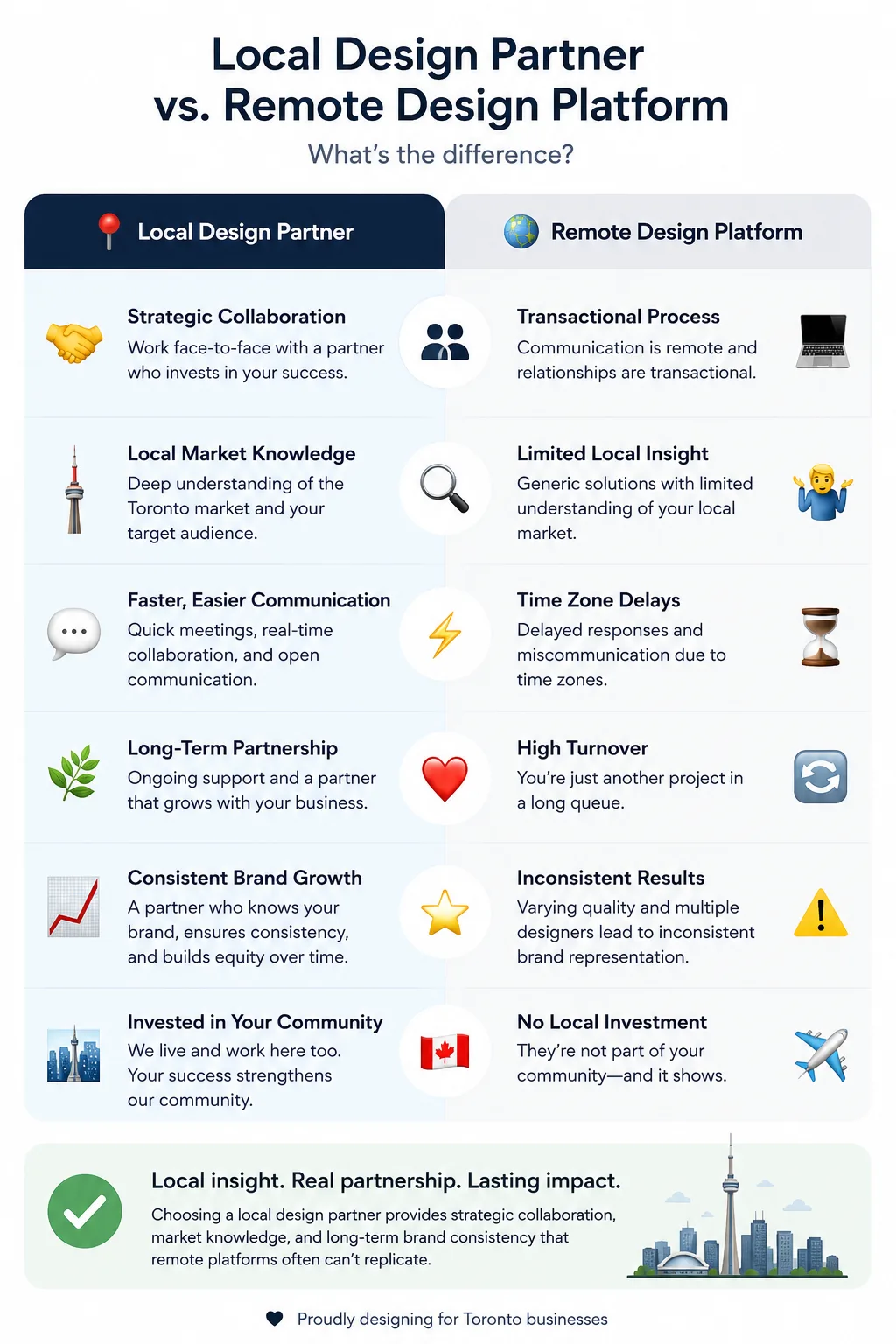
Remote Platform vs Local Design Partner: What's the Difference?
Businesses often compare pricing before comparing value.
While remote platforms can appear attractive because of their monthly subscription model, the experience they provide is fundamentally different from working with a dedicated local creative partner.
Remote Design Platform
Designers may change from project to project
Requests are managed through a queue
Limited understanding of your local market
Primarily focused on production
Relationship ends with completed tasks
Local Toronto Design Partner
One dedicated creative partner who understands your business
Direct communication and faster collaboration
Knowledge of Toronto industries, competitors, and client expectations
Strategic creative guidance alongside production
Long-term partnership that evolves with your business
Neither approach is inherently wrong.
If your business only needs occasional production work, a subscription platform may be enough.
However, businesses investing in long-term growth often discover that consistency, strategic thinking, and brand familiarity deliver significantly more value than simply completing more design requests.
Brand Knowledge Becomes More Valuable Every Month
One of the greatest advantages of working with the same creative partner is something that can't easily be measured.
Context.
The longer a designer works with your business, the more informed every creative decision becomes.
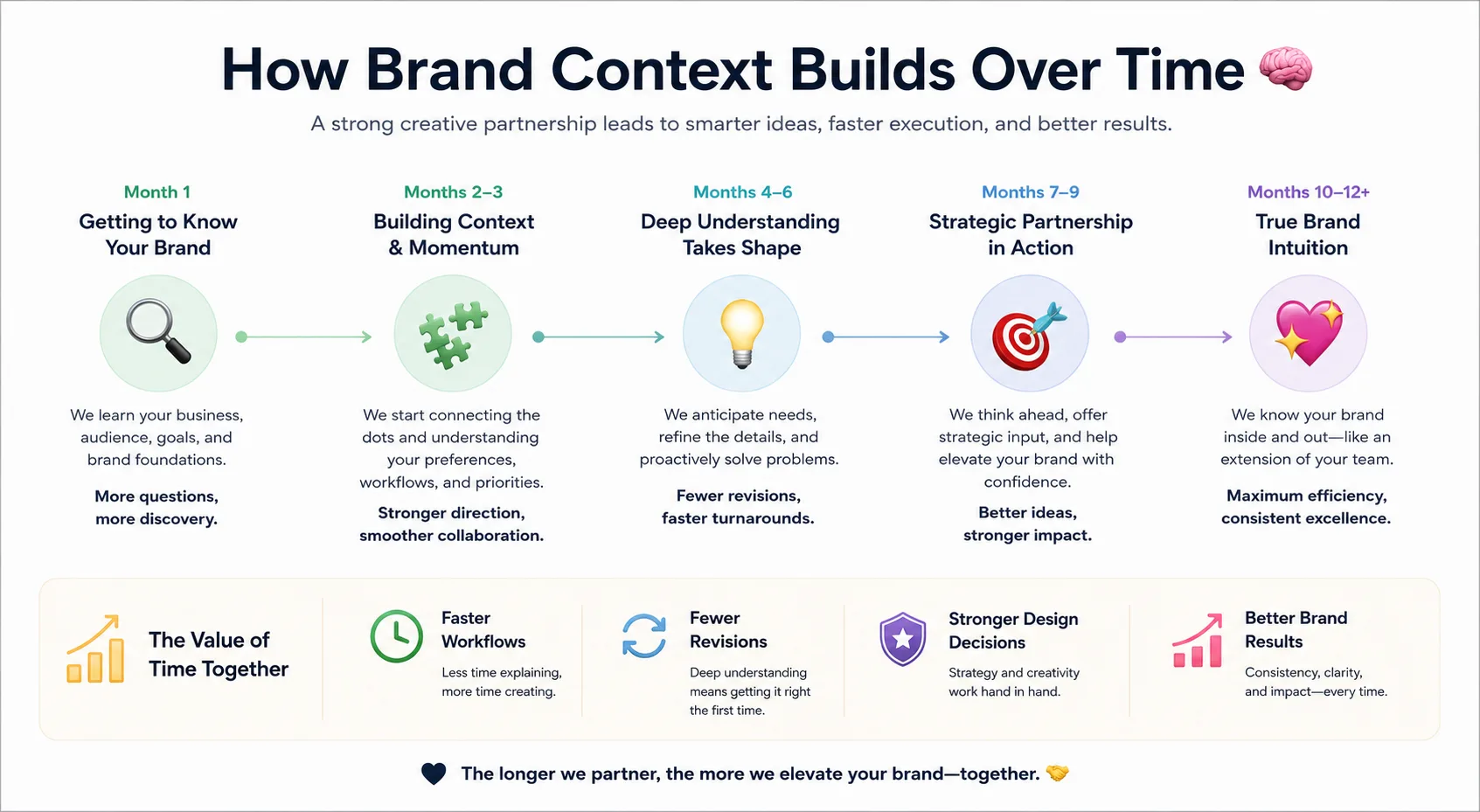
During the first month, they're learning your brand.
By month three, they're anticipating your preferences.
By month six, they're identifying opportunities before you ask.
By the end of the first year, they're no longer simply designing graphics.
They're helping protect and strengthen your brand.
This accumulated knowledge allows projects to move more efficiently because less time is spent explaining your business and more time is spent improving it.
The relationship becomes proactive instead of reactive.
For professional service firms that rely on reputation and trust, this continuity is incredibly valuable.
As a creative partnership develops, consistency becomes easier to maintain because your designer understands not only your visual identity but also your business goals and customer expectations. This long-term understanding helps create a stronger, more reliable brand experience across every touchpoint. As discussed in Harvard Business Review's article on building a brand, businesses succeed by consistently delivering on their brand promise rather than treating branding as a series of disconnected marketing activities.
Why Local Collaboration Still Matters in a Hybrid World
Some businesses assume that because meetings happen online, location no longer matters.
In reality, hybrid work has made local expertise even more valuable.
Most communication may happen through email or video calls, but your business still operates within the Toronto market.
Your competitors are local.
Your networking events are local.
Your clients often have local expectations.
A local design partner understands these realities because they experience them too.
They know how businesses present themselves at Toronto conferences, Chamber of Commerce events, industry associations, networking breakfasts, and professional speaking engagements.
That awareness influences everything from presentation design to printed marketing materials.
When your creative partner understands the environment your brand appears in, their recommendations become more relevant.
The Local Advantage Goes Beyond Design
One benefit that is often overlooked is strategic collaboration.
Over time, your designer begins to notice patterns.
Perhaps your proposals are becoming too text-heavy.
Maybe your social media posts are performing better when they're simplified.
Perhaps your presentations would benefit from stronger visual storytelling.
These recommendations don't appear because someone completed a design request.
They happen because someone understands your business well enough to identify opportunities for improvement.
That's the difference between hiring someone to create graphics and partnering with someone who contributes to your growth.
A strong Toronto design studio doesn't simply ask, "What would you like designed?"
It also asks, "What are you trying to achieve?"
That subtle difference changes the entire relationship.
How Local Businesses Build Stronger Brand Consistency
Consistency isn't achieved through a logo.
It's achieved through repetition.
Every proposal.
Every presentation.
Every LinkedIn post.
Every downloadable guide.
Every website update.
Every client-facing document becomes another opportunity to reinforce your brand.
When different designers create these assets independently, small inconsistencies naturally appear.
Typography changes.
Colours drift.
Layouts evolve.
Messaging becomes less focused.
These inconsistencies rarely happen overnight.
They accumulate slowly until the brand no longer feels unified.
Working with one creative partner significantly reduces this problem because every new asset is built on the same visual foundation.
Adobe's branding resources also emphasize the importance of maintaining consistent visual experiences across customer touchpoints to strengthen recognition and trust.
Choosing the Right Toronto Design Studio
ot every designer—or every studio—is the right fit.
Before choosing a creative partner, consider questions such as:
Do they have experience working with businesses similar to yours?
Can they explain their creative process clearly?
Do they have a structured onboarding process?
Will you work with the same designer consistently?
Do they understand your industry and target audience?
Are they focused on strategy as well as execution?
Can they scale with your business as your needs grow?
Technical ability matters.
But communication, reliability, and strategic thinking often determine whether a creative partnership succeeds over the long term.
The best design partnerships don't feel transactional.
They feel like an extension of your team.
When your designer understands your goals as well as your brand guidelines, creative work becomes more effective, marketing becomes more consistent, and your business can present itself with greater confidence across every customer touchpoint.
The Best Design Partnership Is Built on More Than Great Design
Finding a designer who can create attractive visuals isn't difficult.
Finding a creative partner who understands your business, your audience, and the market you compete in is far less common.
For premium businesses across Toronto and the GTA, design is no longer just about producing graphics. It's about creating a consistent brand experience that builds trust before a conversation even begins.
Whether someone visits your website, receives a proposal, downloads a resource, or follows your company on LinkedIn, every interaction shapes how they perceive your business. Those touchpoints shouldn't feel disconnected or created by different people. They should feel intentional, professional, and unmistakably yours.
That's why more businesses are moving away from one-off projects and toward ongoing creative partnerships.
A local design partner offers something that remote platforms struggle to replicate: context.
They understand your brand, your business goals, and the expectations of the market you're trying to serve. Instead of treating every request as an isolated task, they help build a visual system that grows stronger with every project.
If your business relies on reputation, relationships, and long-term client trust, investing in consistent design support isn't simply a marketing decision—it's a business decision.
The right creative partnership won't just help your business look more professional.
It will help your business communicate its value more clearly, respond more confidently, and build stronger brand recognition over time.
Growth naturally creates more marketing materials, more communication channels, and more opportunities for inconsistency. Establishing repeatable design systems early helps businesses scale without weakening their visual identity. Forbes explains how maintaining brand consistency during growth, emphasizing that templates, guidelines, and consistent execution become increasingly important as organizations expand.
Frequently Asked Questions
Is hiring a local design partner in Toronto better than using an online design subscription?
It depends on your business goals. Online design subscriptions work well for straightforward production tasks, but businesses that require strategic creative support, brand consistency, and ongoing collaboration often benefit more from working with a local design partner who understands their market and business objectives.
What are the benefits of working with a Toronto design studio?
A local Toronto design studio offers more than convenient communication. They understand the competitive landscape, industry expectations, and customer behaviours within the GTA. That local knowledge can help create designs that feel more relevant, credible, and aligned with your target audience.
What is a design retainer?
A design retainer is an ongoing partnership where a business reserves dedicated creative support each month. Instead of hiring designers for individual projects, companies receive consistent graphic design services as new marketing needs arise.
If you're comparing this model with traditional project-based design, read our guide on What a Monthly Design Retainer Actually Includes.
How much does a design retainer cost in Toronto?
Pricing varies depending on the amount of creative support required, project complexity, and whether the partnership includes strategic design guidance in addition to production work.
For a detailed breakdown, see our article on Monthly Design Retainer Cost in Toronto, which explains the factors that influence pricing and what businesses should expect from different service models.
Is a design retainer worth it for small businesses?
For businesses with ongoing marketing needs, a design retainer often provides better value than repeatedly hiring freelancers for separate projects. It reduces onboarding time, improves consistency, and creates a stronger understanding of your brand over time.
Can a local design partner help with brand identity design?
Yes. Many businesses initially hire a designer for individual marketing materials before realizing their brand lacks consistency. A local creative partner can help develop or refine your Brand Identity Design while ensuring those guidelines are applied consistently across websites, presentations, printed materials, and digital marketing.
Why do businesses switch from freelancers to a design retainer?
As businesses grow, managing multiple freelance projects becomes increasingly time-consuming. Working with one dedicated creative partner improves communication, reduces repetitive onboarding, and creates more consistent branding across all customer touchpoints.
Does location still matter if meetings happen online?
Absolutely. While most collaboration now happens virtually, a local designer still brings valuable market knowledge, understands Toronto's business environment, and operates during the same business hours. Those factors often improve communication, responsiveness, and creative decision-making.
What should I look for when choosing a Toronto graphic designer?
Look beyond the portfolio.
Consider whether the designer:
Understands your industry.
Has experience with businesses similar to yours.
Offers a structured process.
Communicates clearly.
Prioritizes long-term partnerships over one-off projects.
Can scale their support as your business grows.
A successful creative partnership depends as much on communication and strategy as it does on technical design skills.
Your brand deserves more than occasional design. Partner with a Toronto design studio that understands your business, your market, and your long-term goals.
Get in touchPixie Creative is a Toronto-based monthly design partner for GTA professional services firms — including law firms, consulting businesses, and financial services companies. Founded by Maryam, Pixie Creative provides dedicated design support without the freelancer chaos or subscription queue overhead.