You have good taste. You have put effort into your visual presence. You know roughly what you want your business to look and feel like. And yet, something isn't landing. Your brand looks a little off. Your materials feel slightly inconsistent. Nothing is obviously wrong, but nothing looks as sharp as the calibre of your work deserves. This is one of the most common frustrations among founders, marketing managers, and agency leads at growing businesses across Toronto and the GTA. It often shows up as a quiet internal question: why does my business look inconsistent even though everything feels “technically correct”? In many cases, this is exactly what people mean when they describe inconsistent branding — not a lack of design effort, but a lack of structural consistency. And the cause is almost never what they assume. Most people in this situation spend months chasing a creative fix for what is actually a structural problem. They hire new freelancers, write more detailed briefs, update brand guidelines, or switch tools entirely. Results improve temporarily, then drift again. Understanding why this happens is the first step to actually fixing it.
It Is Usually Not Your Brief or Your Taste
Most marketing managers assume they haven’t briefed designers clearly enough. So they compensate by writing longer briefs, adding more reference images, collecting inspiration boards, and increasing review cycles.
The output improves slightly.
But the inconsistency remains.
That’s because the issue is not creative clarity — it is system design.
You can have strong taste, clear direction, and skilled designers and still produce an inconsistent brand if the system delivering that output is fragmented.
This is where most growing companies in Toronto quietly run into inconsistent branding Toronto problems without realizing the root cause.
No amount of creative refinement fixes a broken delivery system. That distinction is what changes the solution entirely.
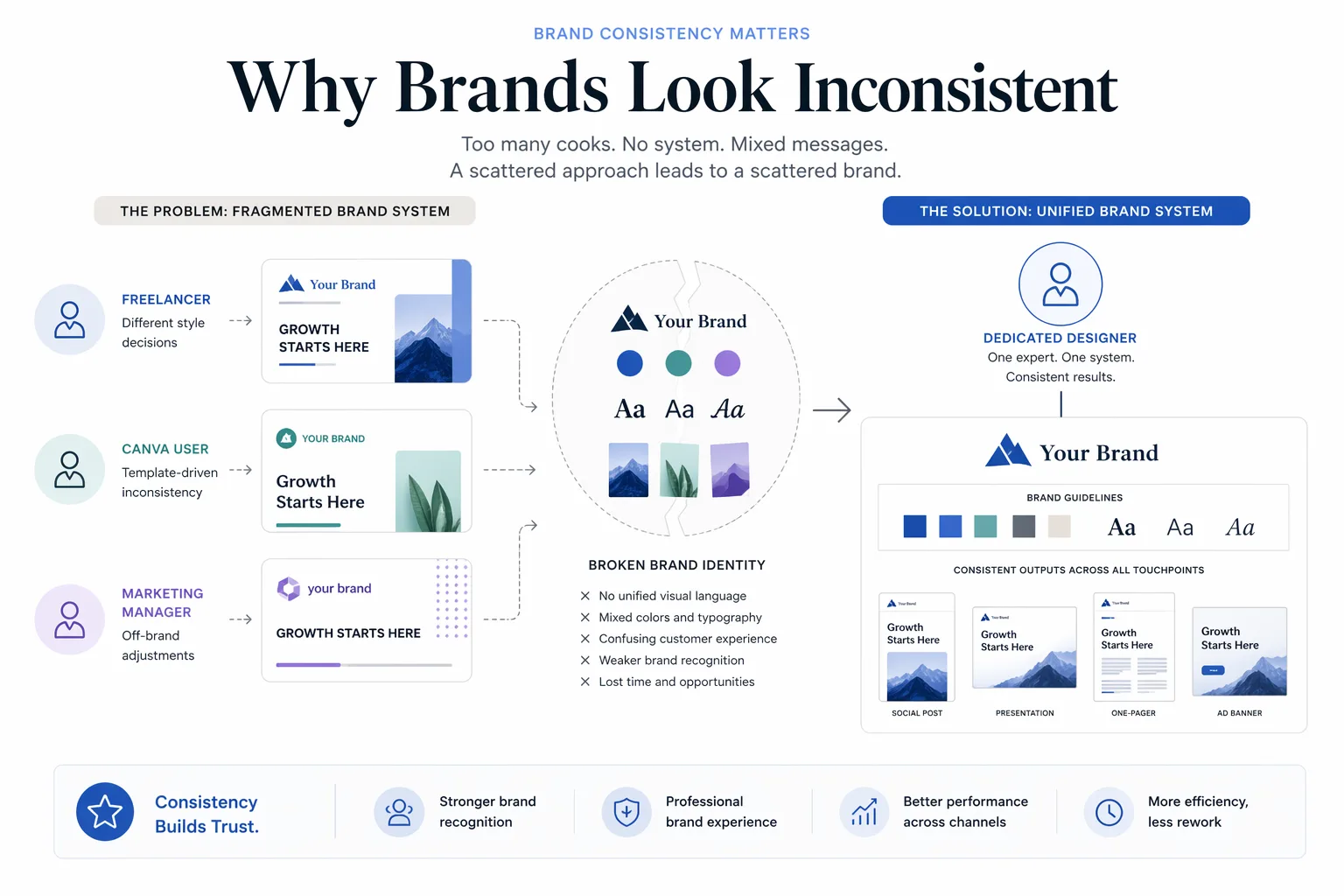
The Three Structural Causes of an Inconsistent Brand
When design work is distributed across multiple freelancers, internal team members using Canva, and occasional agency projects, no one individual is responsible for maintaining consistency across everything.
Each contributor sees only part of the brand.
One freelancer sees a campaign.
One marketer sees social content.
One designer sees a single deliverable.
Nobody sees the full system.
Over time, these small differences accumulate quietly. Not dramatically. Not visibly in isolation. But clearly when viewed together.
Six months later, your LinkedIn posts, pitch decks, internal presentations, and client-facing materials no longer feel like they belong to one unified business.
They feel like variations of the same idea — not one coherent identity.
This is often the moment businesses start saying things like:
“Our brand feels off, but I can’t explain why.”
At scale, this becomes more than a visual issue — it becomes a credibility issue.
This is also where businesses start to feel like their brand looks cheap growing business GTA, even when the work being produced is technically strong.
Research from Stanford Persuasive Technology Lab found that users evaluate a website’s credibility largely based on its visual design, including layout, typography, and overall aesthetics (Fogg et al., 2003).
2. Brand Guidelines Without Brand Enforcement
Most growing businesses do have brand guidelines.
A PDF. A Figma file. A shared drive folder.
It usually contains logos, colours, typography, and maybe a few examples of usage.
But here is the issue:
A brand guide is not a system. It is documentation.
It tells people what “correct” looks like — but it does not ensure that correct output is consistently produced.
Without enforcement, the guide becomes passive.
Design decisions are still made in real time by whoever is producing the asset. That means interpretation replaces standardization.
As highlighted in research from Lucidpress, strong brands are maintained not through documentation alone, but through consistent execution systems that ensure alignment across every touchpoint. Consistent brand presentation has been shown to increase revenue by up to 23%.
3. Production Speed Without Strategic Oversight
As businesses grow, speed becomes a priority.
Content needs to move quickly:
LinkedIn posts before events
Pitch decks before meetings
Campaign assets under tight deadlines
In that environment, quality control is the first casualty.
Technically acceptable work ships. Work that doesn’t reflect the calibre of the business often still gets published.
Over time, this creates a pattern where teams try to fix brand inconsistency marketing team output — but usually by adding more approvals, more tools, or more processes, instead of fixing the structural issue.
The real problem is not speed.
It is speed without a system ensuring consistency.
The Fix
The fix is not:
a better brief
a more detailed brand guide
a new freelancer
or a new tool
These only treat symptoms.
The real fix is structural.
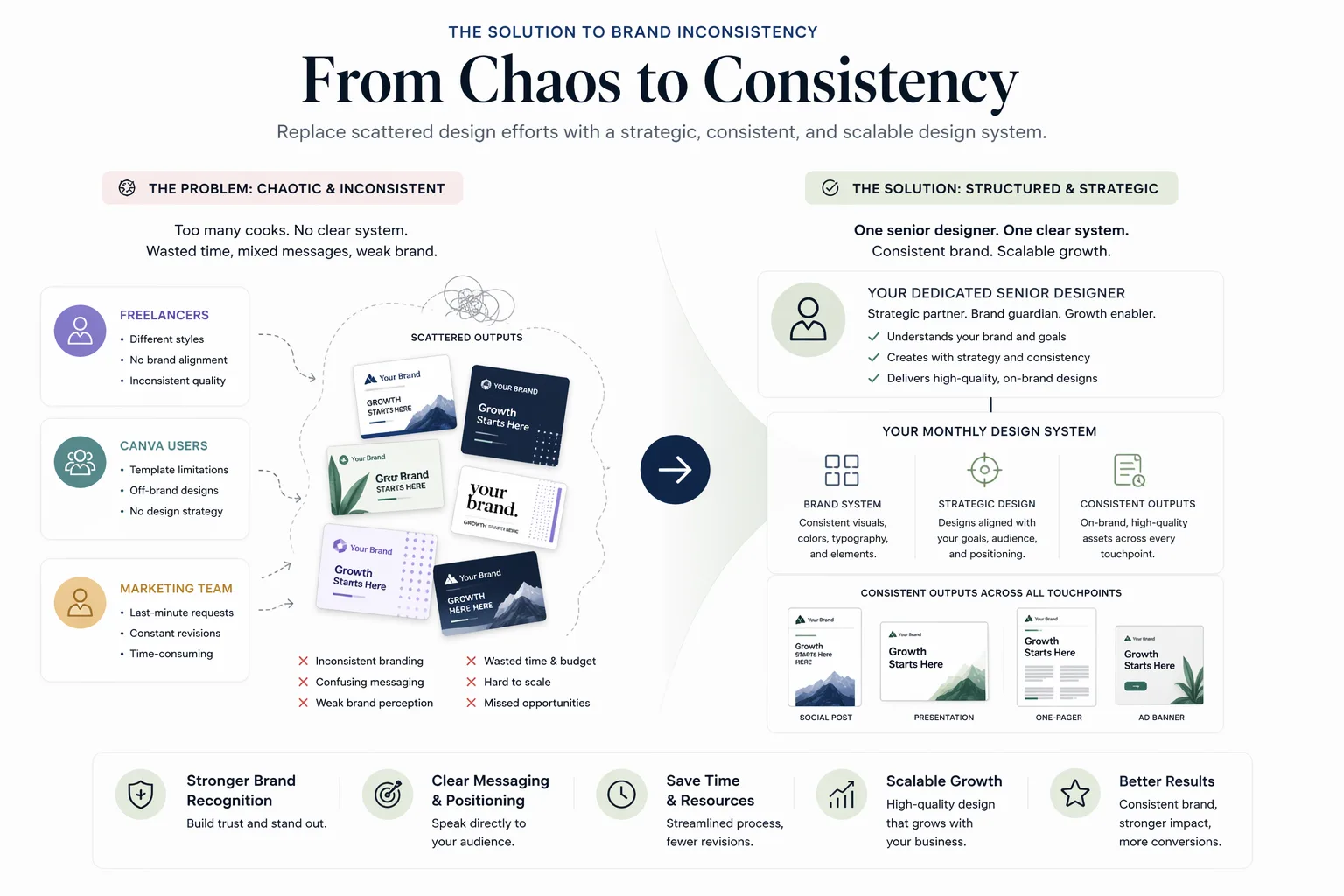
It is having one dedicated senior designer whose entire job is to understand your brand deeply and execute it consistently over time — without constant re-briefing or supervision.
That is the model behind Pixie Creative.
It is designed for growing agencies, scaling businesses, and executive-led teams across Toronto and the GTA that have reached the point where inconsistency is no longer acceptable.
With a dedicated monthly design partner:
One person holds visual standards
Brand guidelines become active systems
Production pressure is removed from internal teams
The inconsistency problem disappears not because people try harder — but because the system changes.
According to research from the Canadian Federation of Independent Business, small businesses spend over 250 hours per year on regulatory and administrative tasks, significantly reducing the time available for core operations and growth.
Related Reading
If you're also exploring why freelancer-based workflows often lead to inconsistency, the post on the real problems with the freelancer model breaks it down further.
And if you're questioning whether your current tools are still enough, the Canva vs hiring a designer Toronto comparison is worth reading alongside this.
Stop wondering why your brand feels off. Book a discovery call with me.
Get in touchPixie Creative is a Toronto-based monthly design partner for GTA professional services firms — including law firms, consulting businesses, and financial services companies. Founded by Maryam, Pixie Creative provides dedicated design support without the freelancer chaos or subscription queue overhead.