Toronto's premium business market has always been competitive. Across the GTA, boutique consultancies, financial firms, legal practices, executive coaches, and professional service businesses are competing for the same high-value clients, referral networks, and market authority.
But in 2026, something has changed.
Businesses are no longer competing only on expertise, pricing, or reputation. They are competing on perception and perception is heavily influenced by how consistently and professionally a company presents itself.
For many growing businesses, design has traditionally been treated as a project-based expense. A new website when needed. A refreshed pitch deck before a big presentation. A few social graphics when marketing gets busy.
That approach worked when businesses had fewer customer touchpoints.
Today, it creates a gap.
The businesses gaining an advantage are recognizing that Graphic design is no longer just about creating attractive visuals. It is becoming a strategic business function that supports credibility, trust, and long-term brand growth.
This is why more Toronto companies are exploring solutions like a Design Retainer, a Monthly Design Subscription, and ongoing partnerships with a Toronto Design Studio instead of relying only on occasional design projects.
What Has Changed in the Toronto Market?
Three major shifts are changing how premium businesses approach design in 2026.
1. AI Has Raised the Standard for Professional Design
The rise of AI-powered design tools has completely changed the creative landscape.
Platforms like Canva AI and Adobe Firefly have made it easier than ever for businesses to create visuals quickly. A company can now generate social graphics, presentations, and marketing materials within minutes.
However, this accessibility has created a new challenge.
When everyone can create something visually acceptable, "acceptable" is no longer impressive.
The standard for premium brands has moved higher.
Professional businesses are no longer competing against outdated templates. They are competing against companies with strong visual systems, intentional Brand Identity Design, and consistent marketing execution.
AI tools are excellent for speed and production, but they do not replace strategic thinking. They cannot understand a company's positioning, audience expectations, competitive landscape, or the subtle visual decisions required to build trust.
The difference between a business using AI-generated graphics and a business with a dedicated creative partner is not the software being used.
It is the strategy behind the work.
2. Buyers Are Becoming More Visually Sophisticated
Toronto's decision-makers are exposed to hundreds of brands every week.
They see polished websites, professional LinkedIn profiles, premium presentations, and carefully designed marketing campaigns every day.
Because of this exposure, they quickly recognize when something feels inconsistent.
A company may offer exceptional services, but if its website feels outdated, its proposal looks rushed, or its social media visuals feel disconnected, prospects may subconsciously question the level of professionalism behind the business.
Brand perception happens before a sales conversation begins.
A consistent visual identity communicates:
professionalism
attention to detail
credibility
stability
confidence
This is why Brand Consistency has become one of the biggest priorities for businesses trying to compete in crowded markets.
3. The Traditional Freelancer Model Has Limitations
Many businesses begin with freelancers because it is flexible and cost-effective.
A freelancer can be the perfect solution for a specific project: a logo update, brochure design, website refresh, or one-time campaign.
The challenge appears when a company begins growing.
Marketing needs increase. Content becomes more frequent. Sales teams need better materials. Leadership wants stronger visibility.
Suddenly, design becomes reactive.
Someone needs a LinkedIn graphic tomorrow. A proposal needs updating next week. A webinar needs promotional materials. A presentation needs a redesign before a client meeting.
The problem is no longer finding someone who can create a good design.
The problem is having reliable creative support available consistently.
This is where an Outsourced Design model or monthly partnership becomes valuable.
Instead of searching for a designer every time something comes up, businesses gain a consistent creative resource that understands their brand, goals, and expectations.
What Does Premium Visual Execution Mean in 2026?
Premium design is not about having the most complicated visuals or the trendiest aesthetic.
It is about creating a brand experience that feels intentional everywhere.
A premium Toronto business should have:
consistent typography across marketing materials
recognizable brand colours
professional presentation templates
cohesive social media graphics
polished client documents
a website that reflects its positioning
This level of consistency does not happen accidentally.
It requires systems.
The businesses succeeding visually in 2026 are not necessarily spending the most money on design. They are the businesses that have made design part of their ongoing operations.
They understand that design is not a final decoration added after strategy.
It is part of how strategy is communicated.
Why Monthly Graphic Design Is Becoming the Preferred Model
Growing businesses often face a difficult choice:
Hire an in-house designer and take on salary, benefits, equipment, and management costs — or rely on freelancers and constantly manage new projects.
A Monthly Graphic Design partnership provides another option.
A dedicated design partner gives businesses ongoing access to creative support without the commitment of a full-time employee.
This approach works especially well for professional service businesses that need regular marketing support but may not require a full internal creative department.
A monthly design partnership can support:
social media graphics
presentations
sales materials
marketing collateral
brand updates
campaign visuals
website graphics
The biggest advantage is not simply getting more designs completed.
It is building momentum.
A designer who understands your business over time can make faster decisions, maintain consistency, and create stronger work because they understand the bigger picture
The Shift From Hiring Designers to Building Creative Infrastructure
For many growing businesses, the biggest challenge is no longer finding talented designers.
Toronto has no shortage of creative professionals.
The challenge is building a reliable system where design can support business growth consistently.
This is the difference between hiring design help and building a creative infrastructure.
A business that relies only on individual projects often operates reactively:
A proposal needs updating before a meeting.
A sales presentation needs redesigning before a pitch.
Marketing needs new visuals for an upcoming campaign.
Leadership wants better LinkedIn content.
A website page needs new graphics.
Each request becomes a separate project.
The business spends time finding availability, explaining the brand again, reviewing different styles, and managing deadlines.
Over time, the hidden cost is not just money.
It is lost momentum.
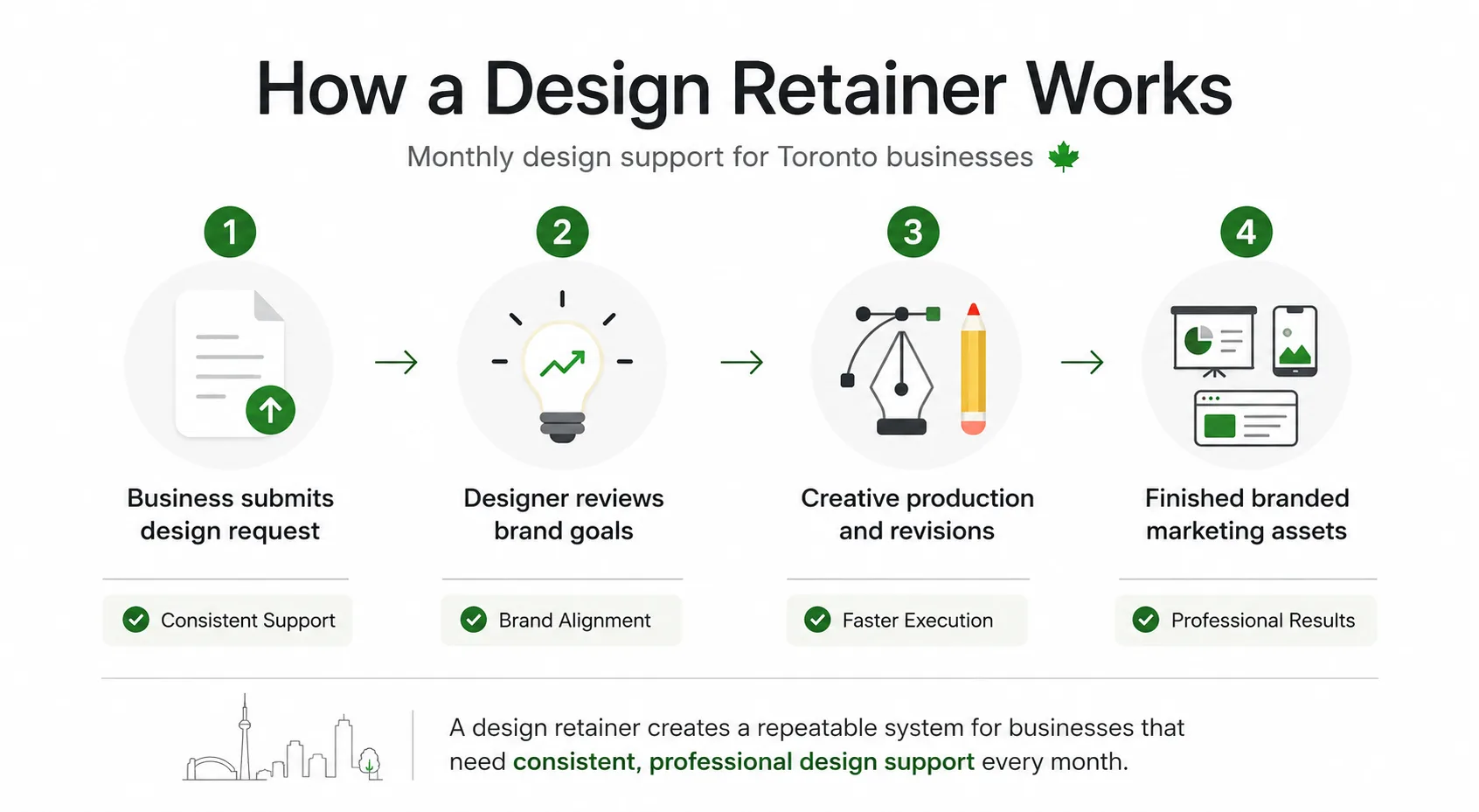
A Design Retainer changes this model by creating an ongoing relationship between the business and its creative partner.
Instead of starting from zero every time, the designer already understands:
your brand positioning
your audience
your preferred visual style
your business goals
your marketing priorities
This creates faster execution and stronger creative decisions.
Businesses that rely on occasional projects often reach a point where a monthly design retainer becomes a more efficient solution, especially when marketing needs become consistent and ongoing.
Design Retainer vs Monthly Design Subscription: What Is the Difference?
As more businesses look for flexible design support, two models have become increasingly popular: design retainers and monthly design subscriptions.
Although they sound similar, there are important differences.
What Is a Design Retainer?
A Design Retainer is an ongoing agreement between a business and a designer or design studio.
The business reserves creative capacity every month in exchange for consistent design support.
The focus is usually on:
strategic collaboration
brand consistency
ongoing business needs
deeper creative understanding
A retainer works best when design is an important part of marketing and business development.
For example, a consulting firm may need:
LinkedIn thought leadership graphics
presentation templates
proposal documents
webinar materials
case study layouts
website updates
Rather than outsourcing each task separately, the company has a dedicated creative resource supporting the entire brand ecosystem.
What Is a Monthly Design Subscription?
A Monthly Design Subscription is usually a packaged service where businesses pay a fixed monthly fee for access to design requests.
Many subscription services focus on speed and production volume.
They can work well for businesses that need frequent design tasks but do not require deeper brand involvement.
However, businesses should evaluate whether the service provides:
strategic thinking
brand understanding
communication support
consistency over time
A premium business usually needs more than completed design files.
It needs a creative partner who understands why those designs exist.
Why Toronto Businesses Are Choosing Dedicated Design Partners
The idea of a dedicated design partner has become increasingly attractive because businesses are facing a new reality.
Marketing is no longer occasional.
Businesses are expected to consistently show up across multiple platforms.
A professional services firm may need:
LinkedIn content every week
updated sales materials
branded newsletters
event graphics
downloadable resources
presentation decks
website updates
The volume of creative needs has increased, but most businesses do not need a full-time designer.
This creates a gap.
A Dedicated Design Partner fills that gap.
It provides access to ongoing creative support without the cost and commitment of an internal hire.
For many Toronto businesses, this model creates the right balance:
more consistency than freelancers
more flexibility than hiring internally
more strategic involvement than production-only services
Why Local Expertise Matters When Choosing a Toronto Design Studio
Design does not exist in isolation.
Every market has visual expectations.
A technology startup in San Francisco may communicate differently than a financial consulting firm in Toronto.
A luxury service provider in Yorkville may require a different visual approach than a growing local business in the GTA.
This is why choosing a local Toronto Design Studio can provide an advantage.
A designer who understands the Toronto market has a better understanding of:
competitive positioning
local business expectations
professional service aesthetics
audience behaviour
industry standards
The goal is not simply to create attractive visuals.
The goal is to create visuals that feel credible to the people you want to attract.
A business should not look like every other company online.
It should look like the strongest version of itself within its market.
Brand Identity Design Is More Than a Logo
One of the biggest misconceptions businesses have is believing branding begins and ends with a logo.
A logo is only one part of a much larger system.
Effective Brand Identity Design creates a complete visual language that helps customers recognize and trust a business.
A complete brand identity may include:
logo system
typography guidelines
colour palette
photography direction
graphic elements
presentation templates
social media guidelines
marketing assets
The purpose is not simply aesthetics.
The purpose is recognition.
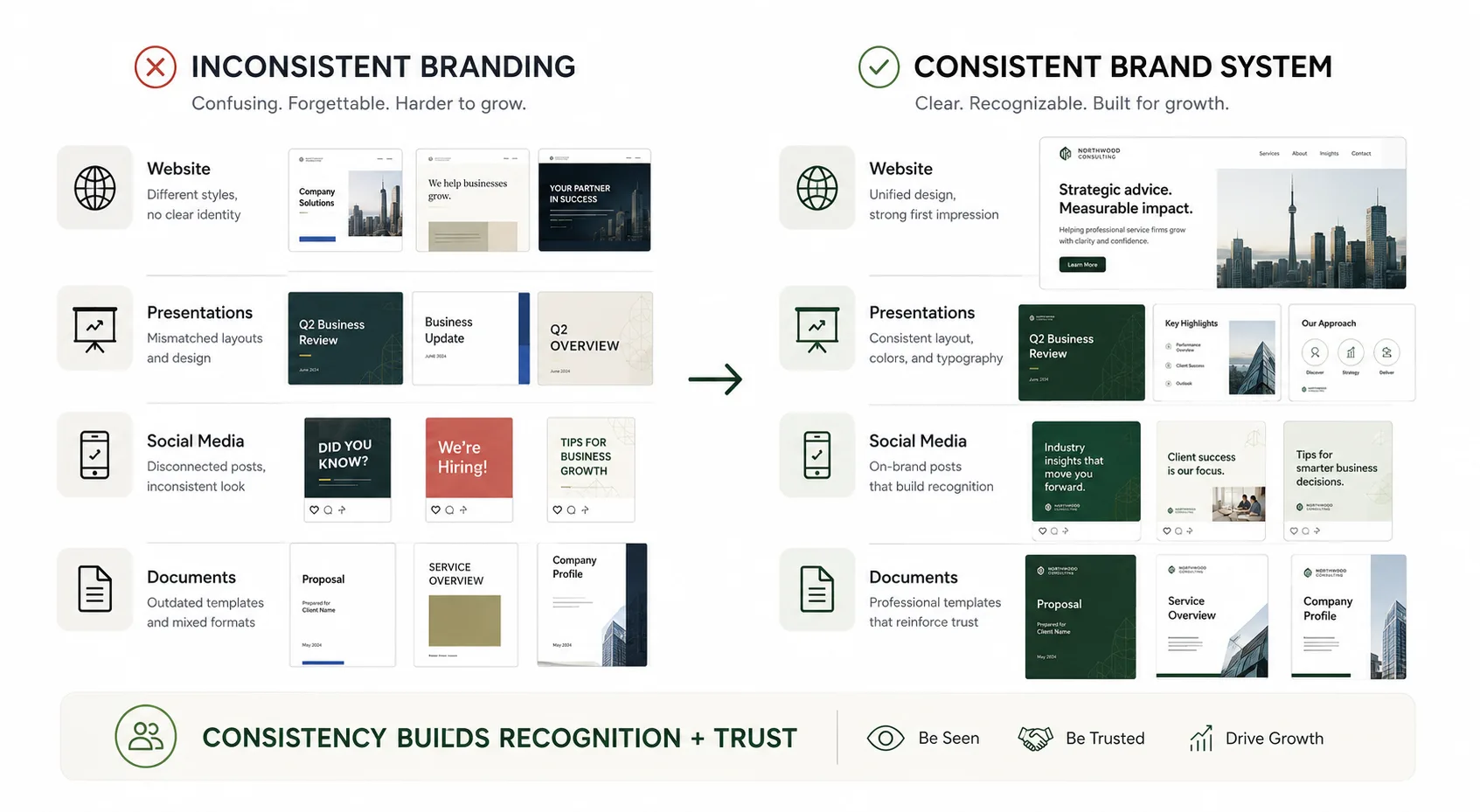
When customers see a company's website, LinkedIn post, proposal, or presentation, they should immediately understand that everything belongs to the same organization.
This consistency builds familiarity.
And familiarity builds trust.
According to Adobe's research on brand consistency, maintaining a recognizable and cohesive identity across customer touchpoints helps organizations create stronger brand experiences.
Adobe — Guide to Consistent Brand Identity
For Toronto businesses competing in premium markets, this consistency can become a significant differentiator.
The Cost of Inconsistent Branding
Many businesses underestimate how much inconsistent visuals affect perception.
A company might have:
a professionally designed website
outdated presentation templates
inconsistent social graphics
different fonts across documents
old marketing materials
Individually, these issues may seem small.
Together, they create friction.
Potential clients may not consciously think:
"The typography is inconsistent."
But they may think:
"This company does not feel as established as others I have seen."
Professional buyers make decisions based on signals.
Design is one of those signals.
Research from Nielsen Norman Group shows that users form impressions of digital experiences quickly, highlighting the importance of clear, professional, and trustworthy presentation.
Nielsen Norman Group — UX Research Articles
For service businesses where trust is essential, these first impressions matter.
When Should a Business Consider a Monthly Graphic Design Partnership?
A monthly design model is not right for every company.
It works best for businesses that:
publish content regularly
have ongoing marketing needs
want stronger brand consistency
are growing beyond DIY design
need reliable creative support
Common signs you may have outgrown project-based design include:
You Are Spending Too Much Time Managing Design
Business owners and marketing teams often become accidental project managers.
They spend hours searching for designers, explaining requirements, reviewing revisions, and organizing files.
That time could be spent on revenue-generating activities.
Your Brand Looks Different Everywhere
If your website, social media, presentations, and documents feel disconnected, your business may need a stronger visual system.
Marketing Has Become More Frequent
Growth creates more creative demand.
A business that needed five designs a month may eventually need twenty.
The solution is not always hiring internally.
Sometimes the better solution is building a flexible external creative team.
The ROI of Investing in Consistent Design
Many businesses still view design as a cost.
A new website costs money. A brochure costs money. A presentation redesign costs money.
But premium businesses increasingly view design differently.
They see design as an investment in how effectively their expertise is communicated.
For professional service businesses, the product being sold is often intangible.
A consulting firm sells expertise.
A financial advisor sells confidence.
A law firm sells trust.
An executive coach sells transformation.
Because these services cannot always be evaluated before purchase, clients rely on signals.
Design is one of those signals.
A consistent, professional visual presence helps communicate:
credibility
stability
expertise
attention to detail
market positioning
This is especially important in competitive markets like Toronto, where many businesses offer similar services.
The question is no longer:
"Can we afford professional design?"
The better question is:
"What does inconsistent design cost us?"
A company may lose opportunities because prospects:
do not immediately understand their value
perceive them as less established
compare them against competitors with stronger presentation
overlook their expertise because their communication does not match their capabilities
Good design does not guarantee business success.
However, poor or inconsistent design can create unnecessary barriers between a business and its ideal clients.
Freelancer vs Agency vs Design Retainer: Which Model Works Best?
Businesses often compare three common approaches:
hiring freelancers
working with a design agency
investing in a monthly design retainer
Each model has advantages depending on business needs.
Hiring a Freelancer
Freelancers are often a great option for specific projects.
Advantages:
flexible
cost-effective for one-time needs
access to specialized skills
Challenges:
availability can change
requires repeated onboarding
less strategic involvement
limited capacity for ongoing support
A freelancer may create an excellent logo or website, but maintaining a consistent brand system over time can become difficult.
Working With a Design Agency
Agencies provide larger teams and broader expertise.
Advantages:
access to multiple specialists
strong project management
larger campaign capabilities
Challenges:
higher project costs
less flexibility
smaller tasks may not receive priority
relationship may end after completion
Agencies are often ideal for large launches, but not always for ongoing day-to-day creative needs.
Working With a Design Retainer Partner
A monthly partnership combines flexibility with consistency.
Advantages:
ongoing support
deeper brand understanding
predictable monthly investment
faster turnaround
stronger creative alignment
For growing businesses that need design regularly, this model often creates the best balance.
It allows companies to access professional creative support without building a full internal department.
Why Design Infrastructure Will Become a Competitive Advantage
In the next few years, businesses will increasingly separate into two categories.
The first group will continue treating design as a last-minute task.
They will create materials whenever something is urgently needed.
The second group will build design systems.
They will have:
established brand guidelines
reusable templates
consistent messaging
reliable creative support
organized marketing assets
The second group will move faster.
They will launch campaigns quicker, communicate more confidently, and create stronger impressions because their foundation already exists.
This is why design infrastructure matters.
The advantage is not one perfect graphic.
The advantage is having a system that consistently produces professional communication.
The Future of AI and Professional Graphic Design
AI will continue changing the creative industry.
Businesses will have access to faster tools, automated workflows, and new ways to generate content.
However, the role of professional designers will evolve rather than disappear.
The value of a designer is moving beyond creating individual graphics.
Modern designers provide:
strategic visual decisions
brand thinking
creative direction
audience understanding
consistency management
AI can generate options.
A professional designer understands which option supports the business goal.
The businesses that benefit most from AI will likely be those that combine technology with human expertise.
AI improves speed.
Strategy improves effectiveness.
Together, they create stronger outcomes.
Why Toronto Businesses Are Moving Toward Ongoing Creative Partnerships
The business environment in Toronto is becoming more competitive every year.
Companies are investing more into:
digital presence
thought leadership
content marketing
customer experience
professional positioning
As these areas grow, the need for reliable design support grows with them.
A monthly design partnership allows businesses to stop thinking about design as a series of disconnected tasks.
Instead, design becomes part of the company's growth strategy.
For professional service firms, consultants, and established businesses in the GTA, this shift represents a larger change:
Design is no longer something added after the business strategy.
It is part of the strategy itself.
Frequently Asked Questions
What is a design retainer?
A design retainer is an ongoing agreement where a business reserves consistent creative support from a designer or design studio each month.
Instead of hiring a designer separately for every project, companies receive ongoing access to design expertise.
A retainer is useful for businesses that need regular marketing materials, brand updates, presentations, and creative support.
How much does a design retainer cost in Toronto?
The cost of a design retainer in Toronto depends on factors such as:
amount of design support needed
number of active requests
complexity of projects
level of strategic involvement
Monthly design partnerships can range from smaller packages for occasional support to larger retainers designed for businesses needing consistent creative capacity.
The right investment depends on how important design is to your marketing and growth goals.
Is a monthly design subscription worth it?
A monthly design subscription can be valuable for businesses that need frequent creative production.
It works best when companies have ongoing requests such as:
social media graphics
presentations
marketing materials
branded templates
However, businesses should evaluate whether they need only production or a deeper creative partnership.
For companies focused on long-term positioning, a strategic design retainer may provide more value.
What businesses benefit most from a design retainer?
Design retainers are especially useful for:
professional service firms
consulting companies
marketing teams
growing businesses
B2B organizations
companies investing in content marketing
Businesses that regularly communicate with customers often benefit the most because consistency becomes easier to maintain.
What is the difference between a design retainer and hiring an in-house designer?
An in-house designer becomes part of your company and works exclusively internally.
A design retainer provides external creative support without the costs associated with a full-time employee.
A retainer can be a good option for businesses that need professional design but do not have enough workload for a full-time position.
Why is brand identity design important for businesses?
Brand identity design helps businesses create a recognizable and consistent visual presence.
It includes elements such as:
logo systems
colours
typography
imagery
templates
visual guidelines
A strong identity helps customers recognize a business and understand its positioning.
Can AI replace professional graphic designers?
AI can assist with speed, idea generation, and production.
However, professional designers provide strategy, creative judgment, and brand understanding that AI tools cannot fully replace.
The future of graphic design will likely involve designers using AI tools while focusing more heavily on strategy and creative direction.
How do I know if my business has outgrown DIY design?
Signs include:
your visuals look inconsistent
your team spends too much time creating graphics
marketing materials feel outdated
your business has grown but your branding has not
competitors appear more polished
When design starts affecting how customers perceive your business, professional support can create significant value.
Why choose a Toronto Design Studio instead of an online design service?
A local Toronto Design Studio understands the business environment, audience expectations, and competitive landscape of the GTA.
Local knowledge can help create designs that feel appropriate for your market instead of generic.
Is Pixie Creative a good fit for every business?
Pixie Creative works best with businesses that value professional presentation, consistency, and ongoing creative support.
The Design Retainer model is ideal for companies that want a reliable creative partner rather than occasional one-off design projects.
Ready to stop managing one-off design projects? Discover how a Design Retainer can give your business consistent, strategic creative support. Get in touch with Pixie Creative to start the conversation.
Get in touchPixie Creative is a Toronto-based monthly design partner for GTA professional services firms — including law firms, consulting businesses, and financial services companies. Founded by Maryam, Pixie Creative provides dedicated design support without the freelancer chaos or subscription queue overhead.