When you first launched in the GTA, hiring a local graphic designer for a logo or grabbing a freelancer for a one-off flyer made complete sense. You were moving fast, overhead was tight, and brand consistency was not yet a competitive variable. The one-off model was the right call at that stage.
But something shifts when a professional services firm grows past a certain point. The revenue is real. The clients are serious. The referrals are starting to matter. And suddenly, every piece of graphic design work in Toronto you commission is creating more problems than it solves: brand drift, management overhead, missed timing windows, and materials that don't reflect the calibre of the firm producing them.
If you've been quietly thinking why does my branding look inconsistent? or why do our materials never quite feel right? You haven't lost your edge. You've just outgrown your system.
Here are the five signs that your business is ready for a monthly design retainer, and what it actually costs you to keep doing it the old way.
Sign 1: You're Explaining Your Brand From Scratch Every Time
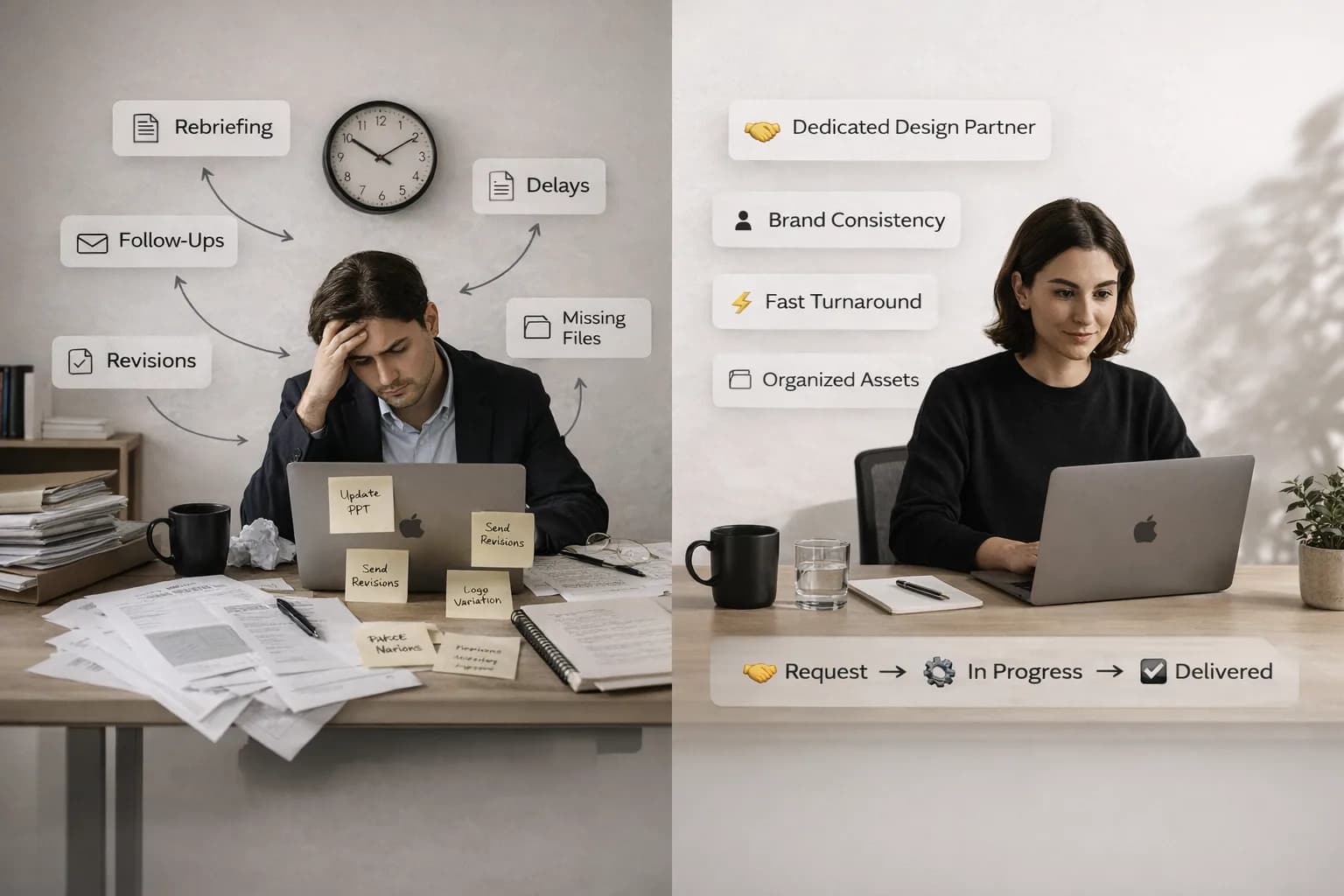
Every new freelancer engagement starts the same way. The colours, the fonts, the tone, your audience, your history, your standards. You send the brand guide. You answer the same questions. The work still comes back slightly off — a different shade of blue, a font that technically fits but doesn't feel right, a layout that's technically correct but not quite yours.
For premium professional services firms in Toronto whether you're running a consulting practice, a marketing agency, a wellness brand, a law firm, or any business where how you show up reflects directly on the quality of what you sell, brand consistency is tied to perceived credibility. When your Instagram looks like it came from a different company than your website, or your event materials don't match your proposals, clients notice. Not always consciously. But they notice.
The re-briefing overhead is not just a time cost. It's a quality cost. Even with a comprehensive brand guide, every new designer needs calibration rounds to understand which tones you use in practice, which level of white space feels right for your audience, which visual structures you actually prefer across your specific mix of deliverables, whether that's social content, brochures, one-pagers, or anything else your business runs on. Each calibration round costs revision cycles. And when client-facing materials need to be right on the first attempt, revision cycles are a deadline risk, not just an inconvenience.
If you've said "just use what we've done before" more than twice in the last month, that's the sign.
Sign 2: A Quick Request Takes Three Weeks
You have a sharp idea for a new service one-pager. You want to capitalize on a LinkedIn conversation that's picking up. There's a capabilities document that needs to be client-ready by Thursday.
But with no dedicated graphic design support in place, the process looks like this: find a local graphic designer with availability, wait for a quote, onboard them, write the brief, review the first draft, revise, approve. By the time the asset is in your hands, the timing window is closed. The post would have landed harder three weeks ago. The one-pager missed the conference. The momentum that existed when the idea was fresh is gone.
In Toronto's premium B2B market, so much of business development is opportunistic and relationship-driven. A thought leadership post published the day a relevant news story lands performs significantly better than the same post published three weeks later when the conversation has moved on. A capabilities document delivered the week after a referral introduction is more likely to convert than the same document sent a month later, when the prospect has had time to explore alternatives.
The one-off model doesn't just slow execution. It systematically misses the timing windows that matter most in relationship-driven professional services markets.
Sign 3: You've Become a Part-Time Project Manager
You didn't build a professional services firm to spend your mornings chasing design updates. Your marketing manager didn't join to spend their afternoons reviewing freelancer work that should have been right the first time.
But that's the hidden tax of the one-off design model. For every project you commission, someone on your team absorbs a management load: sourcing the right person, negotiating scope, writing and re-writing briefs, reviewing drafts, requesting revisions, chasing deliverables, filing the final assets somewhere they can theoretically be found later.
The project manager role is particularly damaging because it's invisible on a job description. Your marketing manager was hired to do marketing — strategy, campaigns, content direction, partner relationships, analytics. The hours they spend managing graphic design projects and reviewing creative output are hours not spent on those functions. But it's also not being counted as a design cost anywhere in the business's budget.
The actual cost of the one-off model, when you account for the internal labour it consumes, is typically 40–70% higher than the invoice alone reflects. That's not a theoretical estimate, it's what firms consistently discover when they calculate the total cost of one-off creative work versus a flat-rate monthly design retainer.
Sign 4: No One Can Find the Files
"Where's the most recent version of the logo with the transparent background?" "Who has the final pitch deck from last quarter, not the one from October, the updated one?" "Is there a version of the proposal template in the right aspect ratio for the client's screen?"
If your team is regularly digging through old email threads, shared drives with no naming convention, and various freelancers' Dropbox folders to find the asset they need, the one-off model is generating operational chaos at a cost that compounds every week.
The asset chaos problem gets progressively worse as a business grows, because the number of asset versions multiplies. There's the original logo and the updated one. The deck from last quarter and the current one. The proposal template and the version customised for a specific client. When these files are scattered across platforms and inboxes, finding the right version becomes a recurring tax on everyone's time.
A dedicated graphic design Toronto partner maintains a single, organised, current asset library as part of their ongoing role, not as a one-off deliverable. Every file is current, named correctly, and accessible. The category of friction called "finding the files" simply stops existing.

Sign 5: You've Started Settling for Good Enough
This is the most telling sign, and the one most founders are reluctant to admit.
You're so worn down by the back-and-forth that you've started accepting work that's just okay. You stop feeling proud of what goes out the door. You post the graphic knowing it's not quite right but it's close enough. You send the brochure with a small internal wince. You hand over the deck, the event flyer, the social content, the email header, whatever your business runs on, knowing it doesn't quite look like the business you've actually built.
The assets are technically done. They're just not you.
Accepting "good enough" visuals in a competitive Toronto market where premium positioning depends on looking the part at every touchpoint is a direct cost to your business. It's not dramatic. It doesn't show up on a report. But it quietly erodes the impression you make with every piece of content you put into the world, every client-facing document you send, every time someone looks you up and forms an opinion before they've spoken to you.
The moment you start sending materials you feel a small apology about "the content is strong, the design is a bit rough." The one-off model has already cost you something that doesn't appear on any invoice.
The Lucidpress State of Brand Consistency Report found that consistent branding can increase revenue by up to 33% — and 81% of organizations still deal with off-brand content, even as most teams are producing more assets than ever before. For premium service businesses, where trust is the product, inconsistent design doesn't just look sloppy. It signals organisational inconsistency at every visual touchpoint — before a single conversation has taken place.
The Sign You're Not Measuring: Your Competitors Are Pulling Ahead Visually
There's a sixth signal that's harder to quantify but increasingly visible across Toronto's premium service landscape: your competitors' materials look sharper than yours. Their Instagram is more consistent. Their website feels more considered. Their brochures, event materials, and client-facing assets look like they came from a business that has its act together, and yours, if you're being honest, look like they came from three different businesses across three different years.
This isn't because they have more in-house design talent or a larger graphic design budget in Toronto. It's because they've made a structural change to how design is handled. They have a design partner who is invested in their brand, not a freelancer who fits them in between seven other clients.
The visual gap opening between you and them is not a gap in talent or budget. It's a gap in design infrastructure and it compounds every month it remains. Whether you're a boutique brand, a service-based business, a studio, or a growing firm of any kind, the businesses in your space that look consistently sharp are not necessarily spending more. They've just stopped treating design as a series of one-off transactions and started treating it as a function.
Firms and businesses that have addressed this infrastructure gap through a monthly design retainer typically describe a specific shift that happens around the six-month mark. Their brand becomes visually coherent across every touchpoint. Their online presence looks consistent and intentional. Their client-facing materials feel polished enough to do some of the selling on their own. And the referral partners, collaborators, or buyers in their world become more confident recommending them because the brand finally matches the business behind it.
According to the Design Management Institute's Design Value Index, design-led companies significantly outperform the broader market over time precisely because design compounds. Every consistent touchpoint adds to a cumulative impression. Every inconsistent one subtracts from it.
Is a Monthly Design Retainer Worth It? What You Actually Get
The honest answer is that a monthly design retainer is not the right model for every business at every stage. It makes the most sense when you're consistently producing four or more design assets per month decks, social content, proposals, marketing materials, one-pagers, and when the cost of brand inconsistency is higher than it was when you were just starting out.
The clearest signal: when you regularly wish you had a designer available without needing to go through the full briefing process. When you want to act on an idea the day you have it, not three weeks later. When you're tired of materials that almost look right.
What a dedicated design partner actually provides beyond the deliverables themselves is design infrastructure: a maintained brand system, organised assets, predictable turnaround times, and creative output that builds on itself rather than starting from zero every engagement. It's the difference between a series of disconnected transactions and a creative function that runs.
Frequently Asked Questions
What is a monthly design retainer, and how does it work?
A monthly design retainer is a flat-fee arrangement with a dedicated graphic design partner who handles your ongoing creative needs, social content, presentations, proposals, marketing materials, for a predictable monthly cost. Instead of sourcing and briefing a new designer for each project, you have one partner who already knows your brand, your standards, and your history.
How do I know if my Toronto business needs a design retainer instead of a freelancer?
The main signal is volume and consistency. If you're producing design work at least four to six times per month, and if brand consistency matters to how your firm is perceived by clients and referral partners, the retainer model will consistently produce better output at a lower total cost than the one-off model.
What's the difference between a branding and design agency and a design retainer partner?
A branding agency typically handles project-based work, such as a rebrand, a campaign, a website build. A design retainer partner handles your ongoing monthly output: the materials you need every week to run and market your business. Both have their place; they serve different phases of a firm's design needs.
Why does my branding look inconsistent even though I have a brand guide?
A brand guide tells a new designer what your brand is supposed to look like. But every new designer still needs calibration rounds to understand how your brand actually behaves in practice your real preferences, your audience's expectations, your implicit standards. That calibration costs revision cycles. A long-term design partner eliminates this because they already know.
How much does graphic design support typically cost for a Toronto professional services firm?
Ongoing graphic design support in Toronto ranges from approximately $1,500 to $3,500+ per month for a dedicated retainer partner, depending on output volume and scope. One-off freelance projects are variable, but when you account for the internal management overhead they consume, the total cost is typically significantly higher per deliverable than a flat-rate retainer.
Is month-to-month commitment available, or do I have to sign a long-term contract?
At Pixie Creative, the retainer operates on a month-to-month basis with no long-term contract required. The relationship is designed to demonstrate its value within the first 30 days.
If any of the five signs above describe your current situation — the constant rebriefing, the slow turnaround, the management overhead, the file chaos, the quiet settling, you haven't made a wrong decision. You've just reached a stage where the model that got you here isn't the model that gets you to the next level.
Book a 15-minute walkthrough with Pixie Creative and see what consistent, on-brand graphic design support actually looks like for a GTA professional services firm.
Get in touchPixie Creative is a Toronto-based monthly design partner for GTA professional services firms — including law firms, consulting businesses, and financial services companies. Founded by Maryam, Pixie Creative provides dedicated design support without the freelancer chaos or subscription queue overhead.