You meet a prospect at a client event in Yorkville, on a referral intro call, or for coffee near King and Bay. The first impression lands perfectly — you are sharp, confident, and credible. As a result, the meeting ends well. Then they go home and do what every prospect does in 2026: they look you up.
They check your LinkedIn. Next, they open the PDF you emailed. They visit your website. Somewhere in that process, the strong impression starts to erode. It happens gradually — not dramatically. Yet the effect on your deal is real. It is enough to slow a decision that should have been easy.
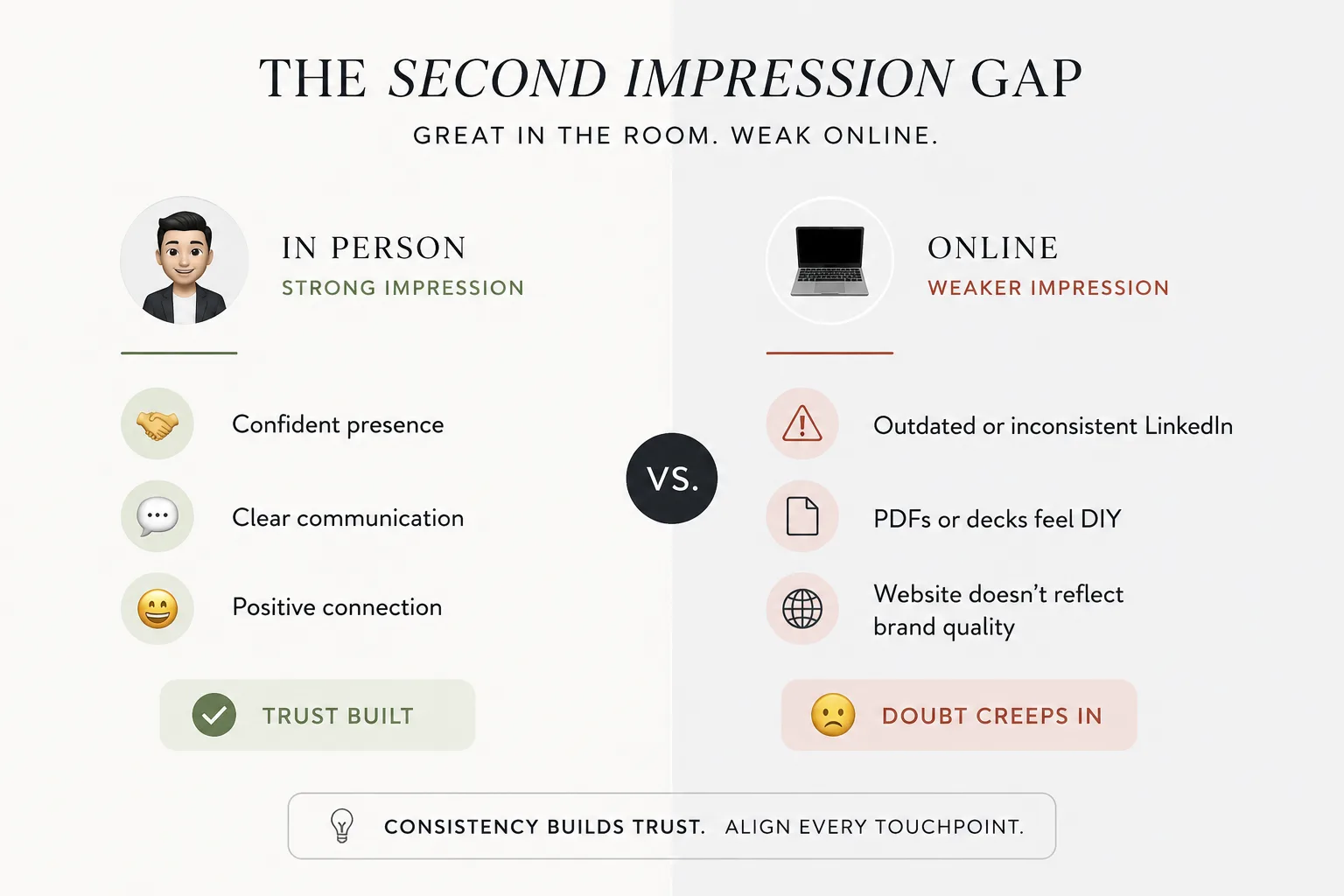
This disconnect is one of the most underdiagnosed reasons deals stall for scaling businesses in the GTA. Specifically, it is the gap between how impressive you are in person and how your digital presence represents you. It creates three specific problems. Understanding them is how you start to close the gap.
The Three Problems the Second Impression Gap Creates
First, doubt.
If your work is world-class, why does your presentation look DIY? The prospect liked you in person. However, the materials they review at home raise a quiet question. Does the quality they experienced in the meeting reflect the full picture?
Second, a disconnect.
The prospect liked you personally but is not sure the infrastructure behind you matches the relationship they are buying into. A strong individual impression and a weak institutional presence create cognitive friction. Consequently, that friction slows decisions.
Third, elevated risk perception.
A significant contract feels riskier when the firm's materials look unfinished. Indeed, visual polish is a proxy for operational reliability. When the polish is missing, the perceived risk of the engagement rises — even if the actual risk has not changed at all.
What Happens in the 48 Hours After Your Meeting
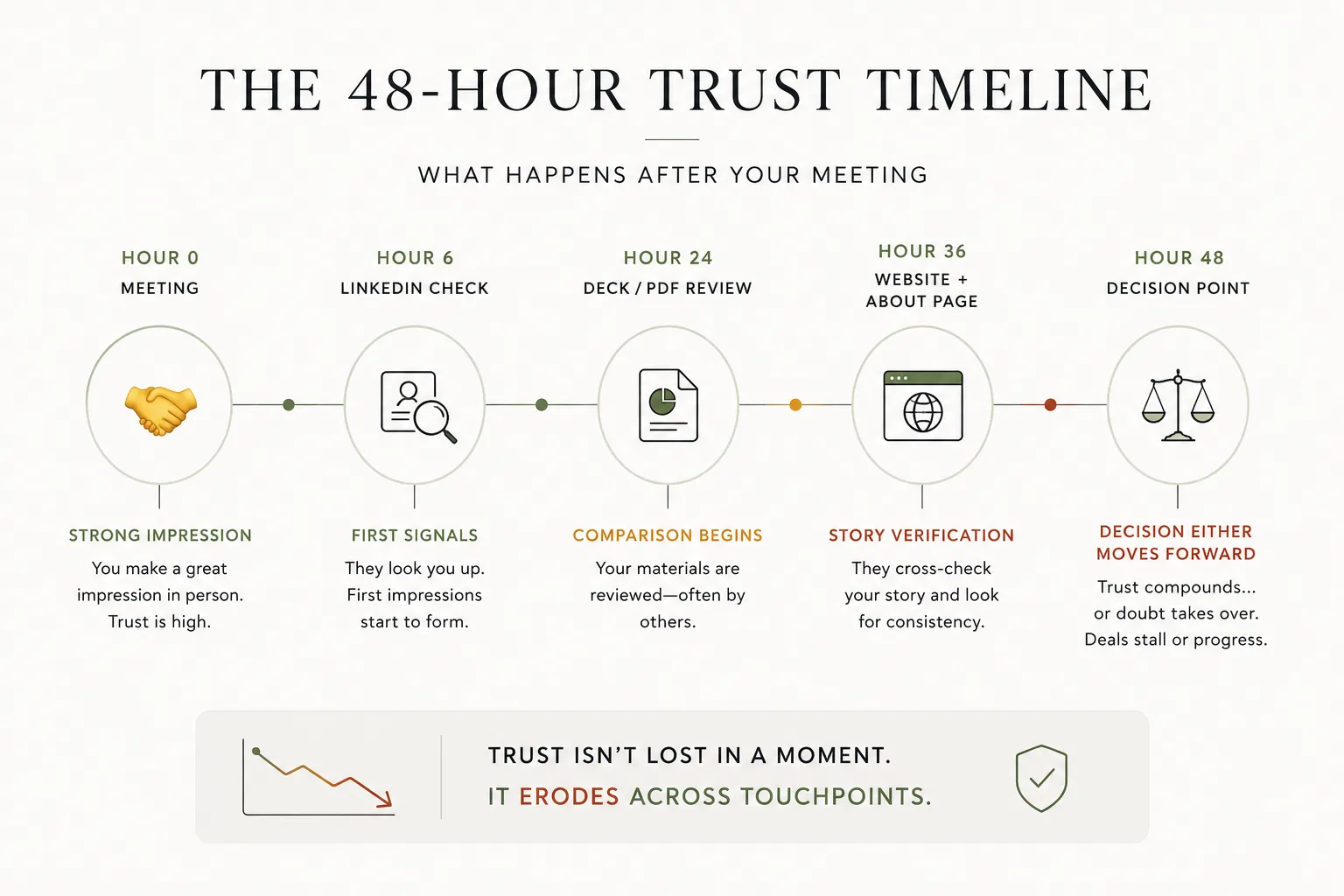
The window between your meeting and their decision is where the Second Impression Gap does most of its damage.
In that window, your prospect forwards your LinkedIn profile to a colleague for a second opinion. The PDF or deck you sent during the call gets reviewed again — sometimes by people who were not on the original call. Your website About page gets checked to verify the story you told in person. Other firms they are evaluating may get compared against your materials directly.
You are not in the room. Your materials are. Ultimately, they determine the outcome.
The committee problem makes this particularly acute for scaling B2B businesses. Notably, it is the dimension of the Second Impression Gap that most businesses never consider. In many executive-level decision-making contexts, the person you met is not the only one deciding. They go back to a partner, a CFO, or a team — and they represent your firm with the materials you gave them.
In other words, your materials make the case when you cannot. If those materials do not hold up under scrutiny, the deal can slow or die in a room you were never in. Consequently, your digital presence and your materials are not just for your prospect. They are for everyone your prospect will consult before saying yes.
The Four Touchpoints Where the Gap Shows Up
For growing businesses in the GTA, the Second Impression Gap typically surfaces in four specific places. Knowing where to look is the fastest way to find and fix it.
is the most visited touchpoint after a meeting — inconsistency here registers immediately with anyone doing a quick check. Research from LinkedIn Business consistently shows that LinkedIn is the primary credibility verification channel for B2B buyers. If your profile does not match the quality of your in-person impression, you lose ground at the most critical moment.
Your PDF or deck
sits in their inbox and gets reviewed multiple times, often by people outside the original conversation. Moreover, it may be the only representation of your business that the people who were not in the meeting ever see. The quality of that document is, for those people, the quality of your firm.
Your website About page
is where buyers cross-reference what you told them against how you publicly describe yourself. Inconsistency between your in-person narrative and your website language creates doubt — even when the substance is identical.
Your email signature
is consistently the most underestimated touchpoint in this audit. Every email you send after a meeting is an opportunity to reinforce the premium impression — or subtly erode it. Notably, most businesses never audit this touchpoint. An outdated signature with the wrong logo version, a missing title, or a broken link is a small but real credibility signal. It accumulates across dozens of post-meeting exchanges. In a market where trust forms through accumulated small signals, getting this wrong consistently matters more than it appears.
Why Consistency Matters More Than Perfection
Research on trust formation in professional service relationships — including findings on the aesthetic-usability effect from Nielsen Norman Group Nielsen Norman Group — Aesthetic-Usability Effect — shows that consistency across touchpoints is among the strongest predictors of purchase confidence. In reality, it outperforms any individual impressive element in isolation. Indeed, fragmented visual presence chips away at the accumulated confidence your in-person impression built — one inconsistency at a time.
The practical implication is this: you do not need to be the most beautifully designed business in the GTA. However, you do need to be the most consistent. In fact, over-design can hurt as much as under-investment. It is not about aesthetics. It is about infrastructure. Specifically, it is the infrastructure that ensures your business looks as good on paper as it does in person — consistently, without manual effort.
Want to see how this trust gap compounds across a full business development cycle? This post on the silent deal breaker covers the full picture.
How to Close the Second Impression Gap
In short, every touchpoint must carry the same story your in-person presence carries: credibility, consistency, and professionalism. Specifically, Pixie Creative works with Toronto founders, agency leaders, boutique business owners, and scaling executive teams to bridge exactly this gap. As your dedicated monthly design partner, every client-facing asset becomes as sharp and consistent online as you are in every room you walk into.
The transformation most clients describe after addressing the Second Impression Gap is cumulative rather than sudden. In other words, it is not a single moment — it is a pattern that builds. Ultimately, it shows up across months. Deals that used to go quiet start converting. That alone is worth the investment. Proposals get faster responses. Additionally, the quality of new enquiries improves. Furthermore, referral partners become more confident sending introductions. The visual presence that was previously working against you becomes an asset. It reinforces every in-person impression you make — even when you are not there to make it.
Frequently Asked Questions
How long does it take to close the Second Impression Gap?
Most founders notice a difference in prospect response quality within the first month. In fact, the change is often visible before they have consciously registered it. The compounding effect — where consistent visual presence builds authority over time — takes three to six months to fully establish. Specifically, the referral network effect tends to be visible around the four to five month mark.
Does this require a full rebrand?
Not usually. For most scaling GTA businesses, the Second Impression Gap is a consistency problem — not a brand identity problem. The fix is updating and aligning existing materials rather than rebuilding from scratch. Specifically, a dedicated design partner identifies which touchpoints are creating the most friction and prioritises those first.
What if our LinkedIn is strong but our proposals are weak?
That specific combination is extremely common. It means your top-of-funnel impression is strong but your close-stage materials are undermining the decision. Furthermore, that gap shows up as deals that start well but go quiet — which is precisely the Second Impression Gap at work. If you recognise this pattern, this post on brand perception and pricing conversations is the right next read.
Book a discovery call and close the Second Impression Gap. Visit pixiecreative.ca.
Get in touchPixie Creative is a Toronto-based monthly design partner for GTA professional services firms — including law firms, consulting businesses, and financial services companies. Founded by Maryam, Pixie Creative provides dedicated design support without the freelancer chaos or subscription queue overhead.