If you run a growing GTA business, you have probably cycled through at least a handful of freelance graphic designers. Some were good. Others were frustrating. Notably, most fell somewhere in the middle, adequate but expensive to maintain. For a scaling agency, consultancy, or marketing-led firm where brand quality is part of the offer, adequate is not good enough.
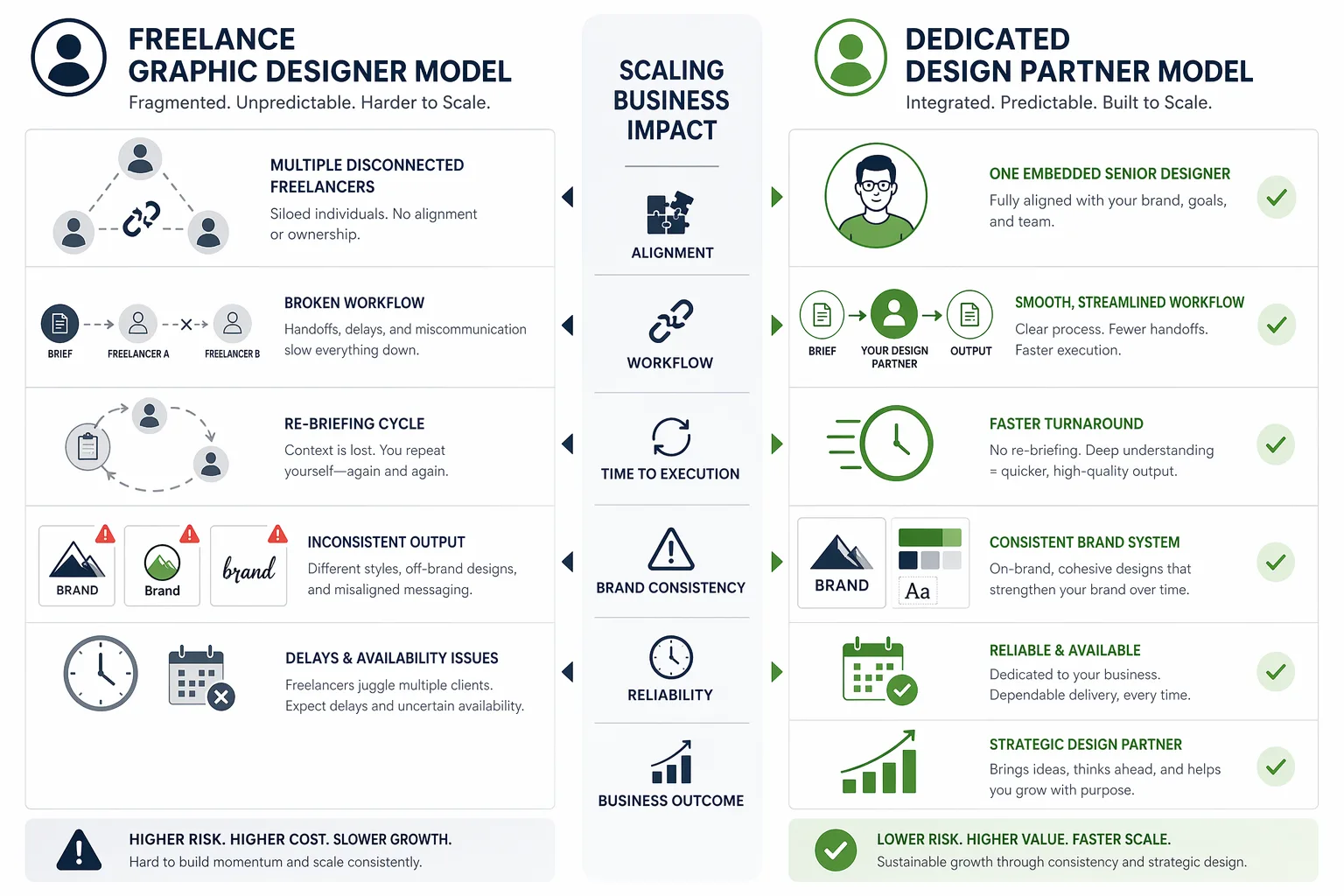
The problem is not the individual freelancers. Most are competent professionals doing their best within the limits of the model they operate. However, the model is the problem — not the people. The real problem is the freelancer model itself. Specifically, it fails growing businesses that need design to work reliably, consistently, and without management overhead.
Problem 1: You Start From Zero Every Time
Every new freelancer means a full brand briefing. Your visual identity, your history, your tone, your standards, your preferences. Even with a brand guide, the first few deliverables from any new designer involve significant back-and-forth. Furthermore, that back-and-forth is time you are absorbing — not the designer. Multiply this across twelve projects a year and you spend a meaningful number of hours just bringing designers up to speed. That overhead is invisible on an invoice but very visible on a calendar. Above all, it is time your marketing manager does not have and time you definitely do not have either.
Notably, even returning to the same freelancer after a gap involves partial re-briefing. In the meantime, they have worked with other clients. Their memory of your brand's specific nuances has faded. You must re-establish the preferences you thought were already set. In other words, you never actually stop re-briefing. Consequently, every re-briefing cycle risks introducing drift. Small deviations accumulate across a year's worth of projects into a brand that looks assembled rather than designed.
According to research from Robert Half, demand for marketing and creative talent in Canada remains high, with 73% of hiring managers planning to increase headcount and 56% reporting it is more difficult to find skilled talent than a year ago—tightening availability and increasing reliance on contract and freelance support.
Problem 2: Availability Is Never Guaranteed
Good freelancers in Toronto are in demand. When a major deadline lands — a client pitch, a conference, an executive presentation — your go-to freelancer may not be available. You end up either waiting, or starting the briefing process with someone new and hoping for the best. This is the structural vulnerability of the freelancer model. Notably, it is the one that causes the most damage.
The most expensive design crises for GTA businesses do not happen on routine projects. Specifically, they happen when a major opportunity requires a polished deck or proposal on short notice and the usual designer is not available. At that point, you face a poor choice. You can delay the opportunity, send materials that are not up to standard, or find a replacement at speed. Each option costs you something significant. None of them are good. Having a dedicated partner eliminates this structural risk entirely. As a result, your most important materials always get the most reliable creative support.
The visual credibility cost of sending under-designed materials to a high-value prospect is real and measurable. This post on the silent deal breaker explains exactly what that costs in business development terms.
Problem 3: Quality Varies More Than You Expect
Even working with the same freelancer over time, quality varies. Their other clients, their workload, their current creative energy — all affect the output. Consequently, when your brand's visual consistency depends on a freelancer's availability and attention, you are taking on risk you have not priced in. Quality variance is more damaging in premium markets than elsewhere. In reality, the gap between your best work and your inconsistent work is what clients remember. Indeed, executive-level buyers in the GTA notice when a firm's materials are inconsistent. That inconsistency raises questions about whether the quality gap extends to the work itself.
According to LinkedIn Workforce Insights data, creative freelancers in Canada average 18 to 24 months before moving to new clients or full-time roles. That means even a freelancer you trust is statistically likely to be gone within two years — taking all of their accumulated brand knowledge with them.
Problem 4: There Is No Strategic Thinking
Most freelancers execute what you specify. They do not ask whether this piece should exist, or whether this format serves your audience, or whether the timing and positioning are right. That strategic layer stays with you. As a result, you are doing two jobs instead of one. For agency owners and marketing managers already stretched thin, this overhead is unsustainable. Ultimately, you end up spending more time directing the work than you would spend doing it yourself. In practice, you end up being the designer, the creative director, and the project manager — while nominally outsourcing design.
What Scaling GTA Businesses Do Instead
The founders and marketing leads who have removed these problems from their operations have moved to a dedicated monthly design partnership. One senior designer, embedded in the business, handles all ongoing creative without briefing from scratch, without availability uncertainty, and without quality variance. The shift changes not just who does the design work but how the entire creative function operates. Ultimately, design stops being a problem you manage and starts being a function that runs.
Marketing ideas reach execution the week they surface. Proposals go to clients looking polished. LinkedIn content shows up consistently and professionally. Furthermore, the marketing manager's calendar no longer carries design work on it.
The business's visual presence starts to compound. Specifically, each month looks more coherent, more premium, and more consistent than the last. This is the compounding return the freelancer model cannot deliver. Accumulated brand knowledge makes every subsequent project faster, better, and more strategically aligned.
By month six with a dedicated partner, the creative output quality typically exceeds what the same business was producing after two years of rotating freelancers. Moreover, the total cost is lower when management time is properly included in the comparison. This guide to what a monthly design retainer actually costs in Toronto breaks down exactly what you get at each tier — and how the numbers compare to what you are currently spending.
Pixie Creative works with scaling businesses — agencies, consultancies, marketing-led firms, and executive teams — as their dedicated monthly design partner across the GTA. In short, it is the structural solution to a structural problem. One designer, one relationship, and no re-briefing from scratch.
If you are not sure whether you have hit the point where the freelancer model is costing more than it saves, the five signs your business has outgrown one-off design gives you a clear checklist.
Frequently Asked Questions
Why does the freelancer model keep failing even when individual freelancers are good?
The issue is structural, not individual. Even the best freelancer starts with no accumulated brand knowledge, no guaranteed availability, and no investment in your marketing strategy. Specifically, those three gaps exist regardless of the freelancer's skill level — because they are built into the model itself.
How long does it take a dedicated design partner to replace the management overhead of freelancers?
Most Pixie Creative clients describe the shift happening within the first four to six weeks. By that point, the onboarding is complete and the designer is producing first drafts that need minimal revision. As a result, the briefing and review overhead drops dramatically. By month three, most requests are a few lines of text rather than a detailed document.
We have a good freelancer right now. Why would we switch?
You are in the best possible position to make this comparison. Run a simple audit. Specifically, count the hours per month you or your marketing manager spend briefing, reviewing, revising, and chasing this freelancer. Multiply that by your hourly rate. Furthermore, consider what happens to your brand quality and marketing output when that freelancer is unavailable. That total cost is what a monthly partnership replaces. Indeed, most businesses that run this audit find the number is higher than they expected.
Replace the freelancer cycle. Book a discovery call with Pixie Creative.
Get in touchPixie Creative is a Toronto-based monthly design partner for GTA professional services firms — including law firms, consulting businesses, and financial services companies. Founded by Maryam, Pixie Creative provides dedicated design support without the freelancer chaos or subscription queue overhead.