As a founder, CMO, or marketing leader in a growing GTA business, your time is your most valuable asset. You know this. Yet if you're honest about your last thirty days, a meaningful portion of them went to reviewing slide decks, adjusting proposal templates, chasing freelancers, or doing design work yourself because no one else could do it fast enough.
Here's the real picture: you're the bottleneck. Every hour you spend in the design queue is an hour you're not spending on clients, revenue, or the strategic work that only you can do.
This is not a time management failure. It's a structural problem — and it has a structural solution. Understanding it clearly is the first step to getting out of it.
Why the Freelancer-by-Project Model Gets More Expensive as You Grow
Many marketing managers and founders handle design reactively: find a freelancer when something's needed, brief them from scratch, review the work, and repeat for the next project. In the early days, this works. As your business grows into a premium market position, it becomes one of the most expensive and time-consuming processes in your operation.
Every new freelancer means starting over on brand context. Every project means a new briefing, a new quote, and a new round of revisions from someone who doesn't know your history or your standards. Every delay means your marketing slows while competitors stay active and visible.
This model also imposes a management tax — the hours you or your team spend coordinating, reviewing, and correcting work that still doesn't look quite right. You haven't removed design from your plate. You've added an invisible management role on top of it.
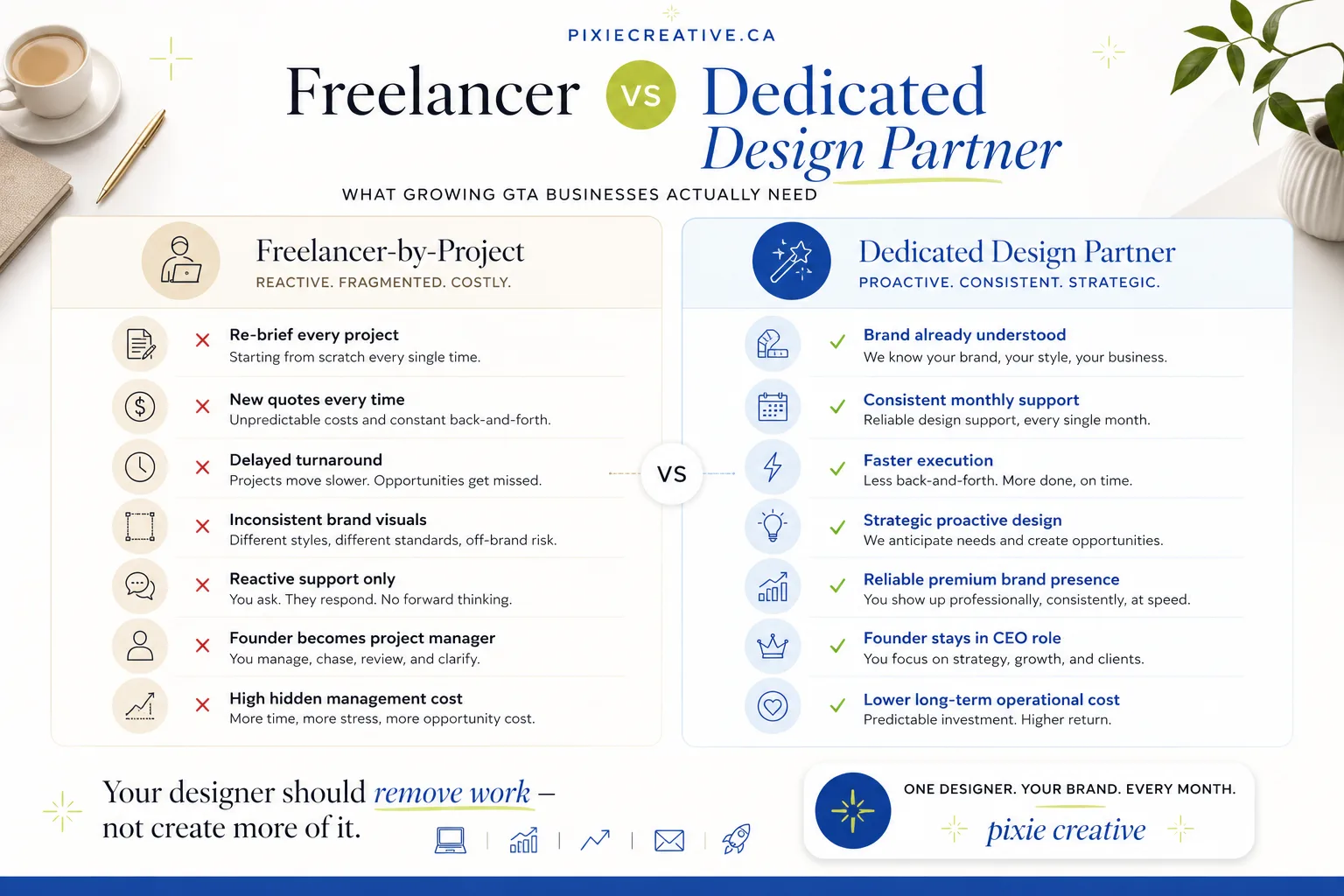
The management tax compounds as your business grows in a specific and painful way. The more important your design deliverables become, the more of your own time you spend on them. A small business can survive sending an imperfect proposal. A premium boutique competing for $20,000 engagements cannot. So as your fees and stakes increase, your involvement in reviewing and approving design work grows proportionally — at exactly the moment when your available time is shrinking. The freelancer model imposes more management overhead precisely when you have the least capacity to absorb it.
The Invisible Cost of Design Context Switching
There's a productivity cost that rarely gets counted: the mental overhead of shifting between strategic work and creative decision-making.
Every time you stop to review a designer's output, give feedback on a layout, or decide whether a deck is ready — you're not just spending those five or ten minutes. You're paying a cognitive tax. Research by Dr. Gloria Mark at the University of California, Irvine, published in "The Cost of Interrupted Work," found that it takes an average of 23 minutes and 15 seconds to fully refocus after a single interruption. That's not the time spent on the interruption itself. That's the recovery time before your brain returns to where it was.
For a founder or CMO experiencing design interruptions three or four times per week, the design queue consumes far more than what shows up on a calendar. The 23-minute recovery cost doesn't look like design time. It looks like the client conversation that didn't happen, the strategic memo that didn't get finished, the business development email that stayed in drafts.
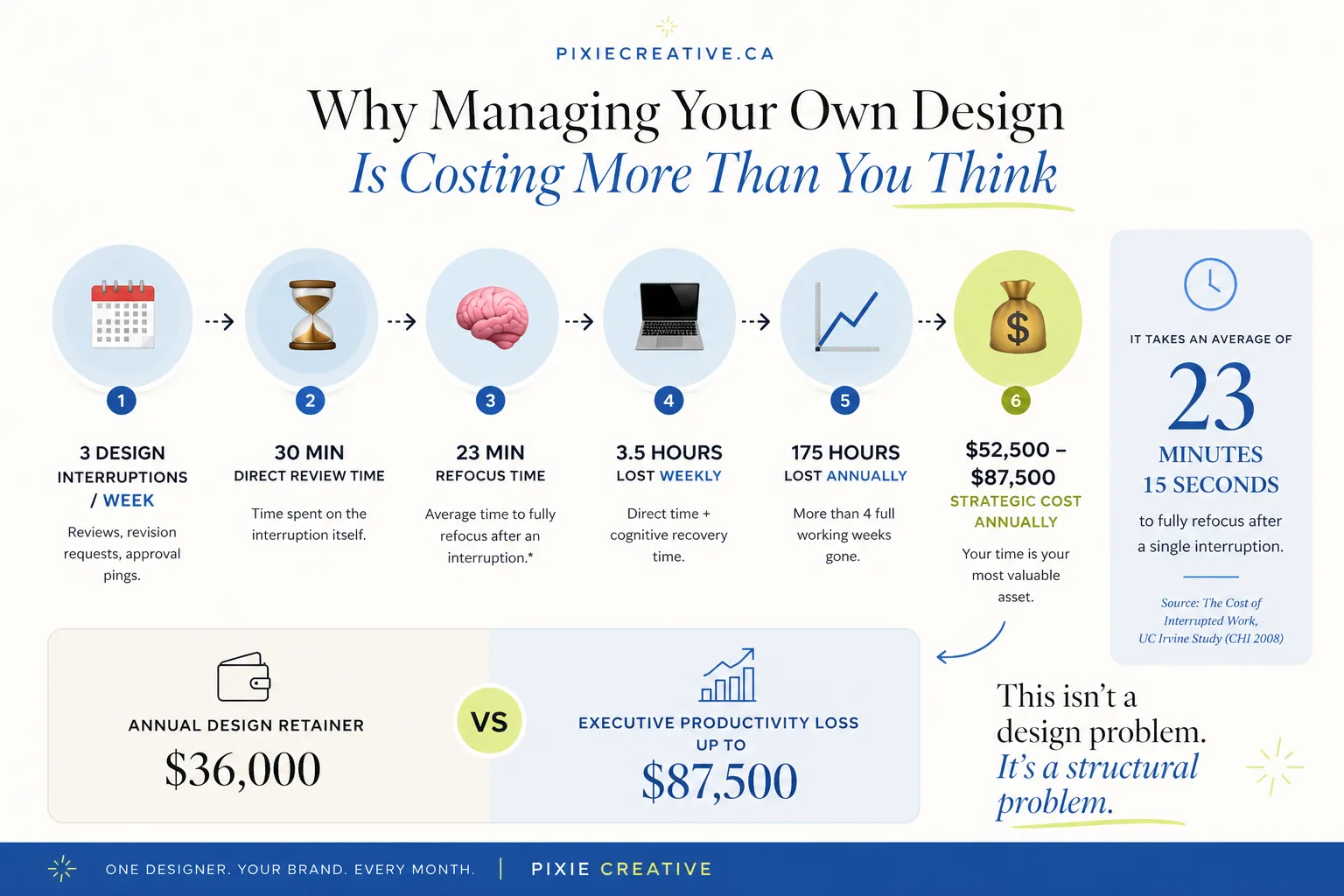
The aggregate annual impact is significant. Three design interruptions per week — reviews, revision requests, approval pings at 30 minutes of direct time plus 23 minutes of cognitive recovery each equals roughly 3.5 hours of productivity impact per week. Over 50 working weeks, that's 175 hours. More than four full working weeks, consumed by design context switching alone, before counting any time you spend doing the design work yourself.
For an executive whose strategic time is worth $300–$500 per hour, the annual productivity cost of this pattern is $52,500–$87,500. Against a $36,000 annual design retainer, the economics are not close.
What Proactive Design Support Actually Looks Like
Imagine design simply happening — reliably, consistently, on-brand — without you initiating it each time.
A dedicated monthly design partner already knows your colours, fonts, communication style, upcoming campaigns, and standards. When you need something, you send a short note and it gets done correctly. When an opportunity surfaces — a webinar, a case study, a new service launch — they're already thinking ahead with you, not waiting to be briefed.
This is what Pixie Creative provides for GTA-based premium boutiques and professional services firms: not a production queue, but an embedded creative partner who handles your design needs with the same reliability as any other core business function. The relationship shifts your involvement in design from execution and oversight to strategic direction, a fundamentally different and far more valuable use of your time.
The proactive element deserves specific attention because it's what distinguishes a genuine partnership from a more efficient version of the freelancer model. When a dedicated partner is embedded in your business and paying attention to your market, your calendar, and your competitive landscape, they initiate work rather than waiting to be briefed. They flag that your capabilities document hasn't been updated since you added a new service. They suggest a LinkedIn series ahead of a conference you're speaking at. They notice your competitor's proposal template looks sharper than yours and flag it before a client does.
That kind of proactive intelligence is impossible to get from a briefing-and-execution model. It requires the relationship depth and business context that only come from a sustained, embedded partnership.
The Hidden Compounding Cost of Keeping the Bottleneck
Every week the design bottleneck stays in your calendar is a week you're not spending on client acquisition, relationship-building, or high-leverage strategy. The GTA market for premium professional services is competitive. The firms gaining ground are the ones who've removed friction from their operations and show up consistently, professionally, and at speed.
There's a compounding competitive disadvantage to keeping the bottleneck in place that goes beyond the lost hours. As Gallup research on workplace interruptions and their business consequences makes clear, the real cost of fragmented executive attention is measured not just in time, but in outcomes that never happen.
When marketing execution is slow because design is a bottleneck, you fall behind in the accumulation of market presence that drives premium business growth. You post less consistently on LinkedIn, so your authority builds more slowly. Proposals take longer to go out, so your response rate on time-sensitive opportunities drops. Thought leadership appears in bursts rather than consistently, so the compounding inbound effect never fully activates. The bottleneck doesn't just cost you time. It costs you the market position that would have built if execution had been reliable all along.
What Removing the Bottleneck Actually Frees Up
When founders and marketing leads remove design from their weekly calendar through a dedicated partnership, the immediate benefit is obvious: the hours come back.
The second-order benefit is more significant: the creative mental load disappears entirely. No more half-formed background awareness of the deck that needs updating. No more Sunday night recognition that the proposal template still carries last quarter's messaging. That low-grade cognitive noise — the awareness of things undone — evaporates when a reliable partner holds the function.
The founders and CMOs who describe this shift consistently reach for the same word: clarity. Not just more time, but a cleaner relationship with strategic priorities. The creative noise is gone. Strategic thinking that design administration had crowded out starts to return. Client relationships get more attention. Business development conversations happen more proactively.
The operational return on removing the bottleneck is measurable in hours. The strategic return shows up in the quality and direction of the business itself.
The clarity that executives describe isn't just psychological; it's operational. When the design function runs reliably, the marketing function starts working differently. Content calendars shift from aspirational to operational. Campaign ideas are executed in the week they're conceived, not the month after. LinkedIn thought leadership appears consistently enough that referral partners start commenting on it in conversation. The business shows up in the market the way it's actually capable of showing up — rather than in the best approximation it can manage while the executive is running everything else simultaneously.
Removing the bottleneck doesn't just free up time. It raises the ceiling on what your business can produce and communicate in every week, every month, and every year going forward.
You Don't Have a Design Problem. You Have a Structural Problem.
The real cost of managing design without a dedicated partner isn't visible on any single invoice or calendar block. It accumulates quietly — in delayed proposals, inconsistent LinkedIn presence, missed campaign windows, and the strategic conversations that didn't happen because you were mentally still in the deck you just reviewed.
Premium businesses in the GTA that win consistently are the ones who treat design as a core function, not a reactive task. They have a partner who knows their brand, anticipates their needs, and executes without a management burden attached.
The question isn't whether you can afford a dedicated design partner. It's whether you can afford to keep being the bottleneck.
FAQ
What is a dedicated designer for GTA businesses?
A dedicated design partner is a creative professional or studio embedded in your business on a monthly retainer. Unlike a freelancer hired per project, they already know your brand, your standards, and your upcoming priorities — so work gets done without a briefing cycle every time.
How much does a monthly design retainer cost in Toronto?
Most GTA-based design retainers for professional services businesses range from $2,500 to $4,500 per month, depending on volume and scope. That figure compares against the $52,500–$87,500 in annual productivity loss that design context switching costs a founder or CMO at a strategic hourly rate.
Why is managing freelance designers so expensive as a business grows?
Because the management tax grows with the stakes. As your fees increase, your design deliverables matter more which means more of your own time reviewing, correcting, and approving work. The freelancer model adds management overhead exactly when you have the least capacity for it.
How does a design retainer remove the founder bottleneck?
A retainer replaces the briefing-approval-revision cycle with an embedded partnership. Your design partner knows your brand without being told. Work initiates proactively. Your involvement shifts from execution and oversight to occasional strategic direction — a fundamentally different demand on your time.
What types of GTA businesses benefit most from a dedicated design partner?
Premium professional services firms, financial boutiques, consulting practices, and marketing-led SMEs in the GTA benefit most. Specifically, businesses competing for high-value engagements where proposal quality, LinkedIn presence, and brand consistency directly influence whether prospects say yes.
How long does it take to see results from outsourcing design in Toronto?
Most founders and marketing managers notice the operational shift within the first four to six weeks, content moves faster, proposals go out sooner, and the background cognitive load of pending design work disappears. The compounding market presence benefit builds over three to six months of consistent execution.
How much does a design agency charge per hour in Toronto?
oronto design agencies typically bill $125–$225 per hour for senior creative work. On a project basis, a single proposal deck can run $1,500–$4,000. A monthly retainer consolidates that spend into a predictable fixed cost and eliminates the per-project briefing overhead that makes hourly agency work expensive at volume.
Is graphic design in demand for Toronto businesses in 2026?
Demand isn't the issue, capacity is. Most growing GTA businesses need more design output than they're currently producing. The constraint isn't finding a designer; it's finding one already embedded in your brand context who can execute at the speed your marketing calendar requires.
Stop being the bottleneck. Book a discovery call at pixiecreative.ca.
Get in touchPixie Creative is a Toronto-based monthly design partner for GTA professional services firms — including law firms, consulting businesses, and financial services companies. Founded by Maryam, Pixie Creative provides dedicated design support without the freelancer chaos or subscription queue overhead.