Design subscription services have grown fast over the past few years. In fact, they now represent one of the most marketed solutions to the design overhead problem. Flat monthly fee, unlimited requests, 24 to 48 hour turnaround. On paper it sounds like the answer to every founder's and marketing manager's design headache. In practice, however, the reality is more complicated. This is especially true for growing agencies and professional service firms in Toronto where brand quality is part of what you are selling.
The post below gives you an honest assessment of what subscription services actually deliver. Specifically, it covers where they fall short for growing GTA businesses and what the alternative looks like.
What Subscription Design Services Do Well
For businesses with high-volume, standardised design needs — social posts, display ads, simple graphics — subscription services can deliver acceptable output at a reasonable cost. If your brief is clear, your brand is simple, and volume matters more than nuance, the model works. Indeed, the turnaround promise is generally real and the unlimited request structure is genuine. For e-commerce businesses submitting thirty social posts a month with a clear visual template, these platforms are a legitimately good fit. Notably, that specific use case is where the model was designed to excel.
Where They Break Down for Growing GTA Businesses
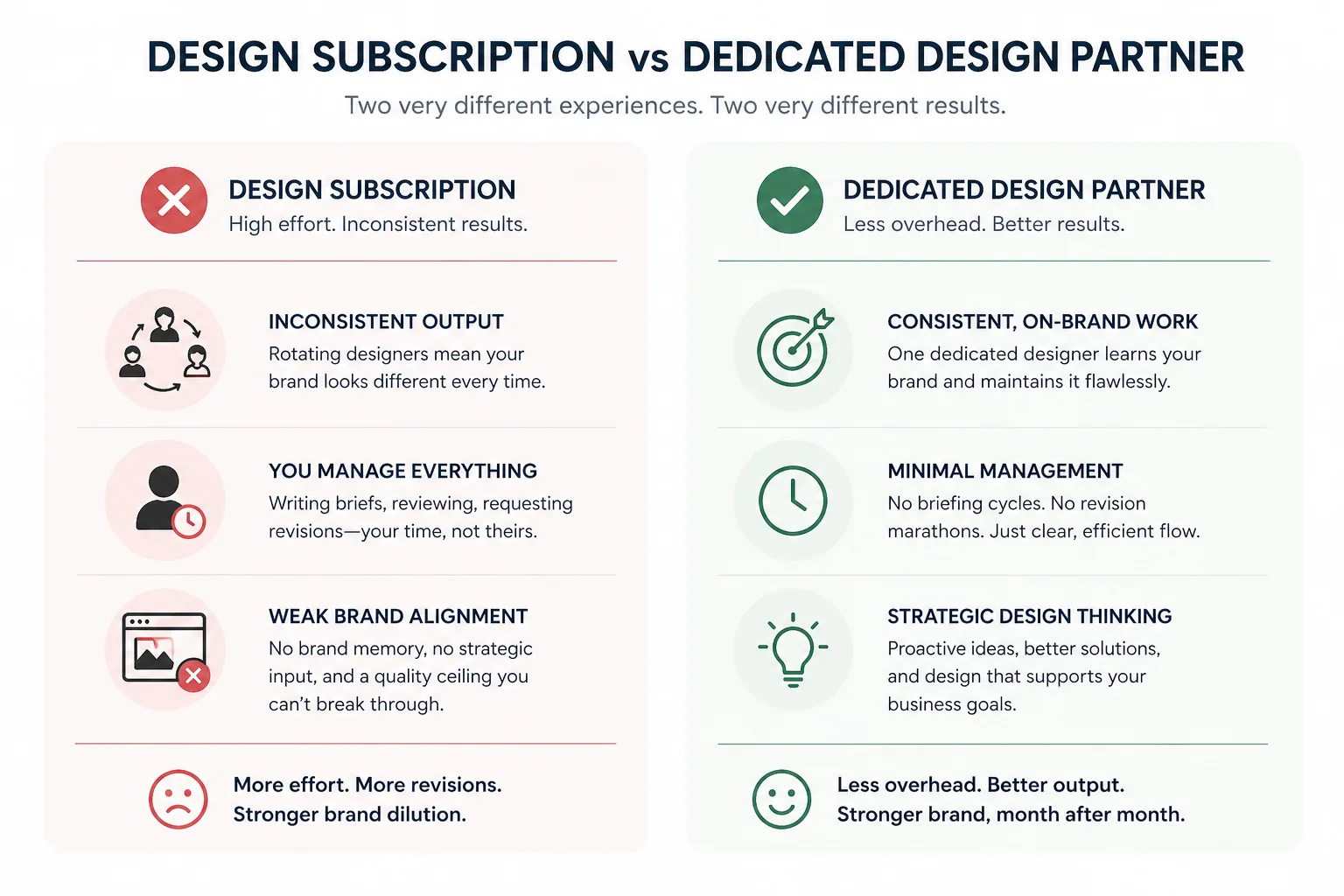
No brand memory
Rotating designers mean your visual standards are held by someone different every time. That is the core structural problem with the subscription model. Consequently, your deliverables look slightly different each month. For a growing business where brand consistency is part of your premium positioning, that inconsistency is not a minor annoyance. Rather, it is a structural barrier to the credibility you are trying to build.
You are still the creative director
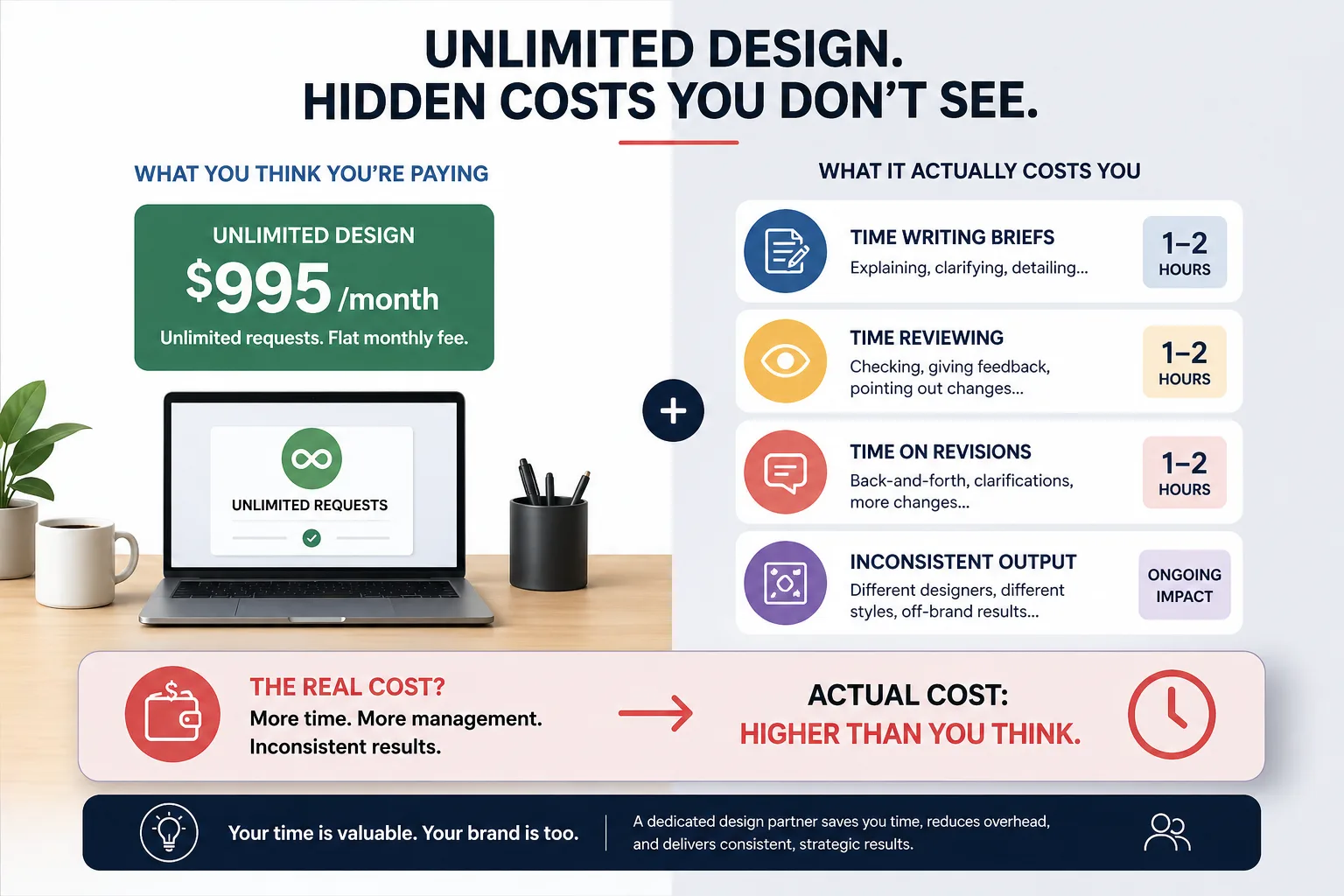
The ticket-based workflow means you write the brief, review the output, request revisions, and approve. In other words, you have not outsourced creative direction — you have outsourced production. The management overhead does not go away — it just gets a new name. Growing GTA business owners who have tried subscription services typically report spending three to five hours per month writing briefs and reviewing output. That overhead should have disappeared when they outsourced design. Instead, it simply moved to a different column on their calendar.
Complex work comes back wrong
The service optimises for simple briefs. Complex requests — a pitch deck for an executive audience, a polished proposal, a thought leadership piece — consistently come back needing significant revision. Specifically, the platform's designers optimise for speed and volume, not strategic complexity. A deck produced by a subscription service is technically competent. A deck produced by a dedicated partner who has spent six months on your account is strategically aligned. These are not the same thing. Indeed, for a pitch going to a major client, the difference is the difference between winning and losing.
No strategic relationship
The platform executes whatever you specify. It does not flag when a content approach is wrong for your audience or suggest a better format for a deliverable. The strategic thinking stays entirely with you. Above all, that is the overhead you were trying to escape — and the subscription model does not remove it.
A quality ceiling nobody admits
The business model of unlimited design at a flat fee requires high throughput. High throughput means working quickly. Working quickly means designers gravitate toward simpler, more predictable briefs. Ultimately, that misalignment is most visible on the work that matters most. The platform's incentives and a growing business's needs are structurally misaligned.
Research on outsourcing knowledge work shows that while execution can be delegated, oversight and strategic direction often remain in-house — which is exactly where many subscription models fall short. Harvard Business Review has explored this dynamic in depth, noting that outsourcing frequently shifts work rather than eliminating it.
The Calculation Worth Running Before You Sign Up
Before committing to a subscription service, run this calculation honestly. Count the hours per month you or your marketing manager will spend writing briefs, reviewing output, and managing revisions. Specifically, be honest about the full number — not just the briefing time. Multiply that by your hourly rate. Add the subscription fee. Compare that number to the cost of a dedicated monthly design partnership. This breakdown of what a monthly design retainer actually costs in Toronto makes that comparison straightforward.
For most growing GTA businesses, the total cost is higher than they expected. Often it is comparable to a dedicated partnership that produces better output with less overhead.
The clearest signal is revision rate. If more than 40 percent of your requests require more than one revision round, the model is not working for your brief complexity. Additionally, if that flicker of apology every time a client-facing deliverable goes out — content strong, formatting rough — that is the quality ceiling at work.
The Alternative Worth Considering
A dedicated monthly design partnership is a different model entirely. Specifically, it is built around relationship and accumulated brand knowledge rather than volume and throughput. One senior designer with deep brand knowledge from day one. Furthermore, they build on that knowledge every month — so the sixth month is faster and better than the first. No briefing cycle for standard requests, no revision marathon. Output that reflects the actual calibre of the firm it represents.
Businesses that make this transition consistently describe the same realisation. The subscription service solved the problem of needing more design. Yet it did not solve the problem of needing better design with less management. Those are different problems requiring different solutions. A dedicated partner solves both simultaneously — more output, better output, and less overhead.
Not sure whether you have hit the point where a subscription service is holding you back? The five signs your business has outgrown the one-off design model gives you a clear framework for the decision.
Frequently Asked Questions
We are currently using Design Pickle. Is it worth switching?
The honest answer depends on your specific use case. If your design needs are primarily high-volume, templated social content, Design Pickle may be adequate. However, if you regularly produce client-facing pitch decks or proposals, the quality ceiling and management overhead will cost you more than the fee saves. Specifically, the test is this: add up the hours your team spends managing the platform per month and multiply by your team's hourly rate. If the number approaches the subscription cost, the economics do not favour the platform.
At a broader level, inefficiencies in knowledge work often come from coordination overhead rather than execution itself. McKinsey & Company has consistently found that productivity losses stem from fragmented workflows — a pattern that mirrors how subscription-based design models operate in practice.
Can I use a subscription service for some things and a dedicated partner for others?
Yes — and notably, this is a common arrangement for growing GTA businesses. Specifically, subscription services can handle high-volume, low-stakes social content while a dedicated partner handles everything client-facing and strategically important. In practice, most businesses find the subscription increasingly unused within three to four months. The dedicated partner absorbs more of the volume at a higher quality level.
How do I know if I have outgrown the subscription model?
Furthermore, there is a cost the hours calculation does not capture: brand consistency. Subscription services cannot hold your brand standard across rotating designers, regardless of how detailed your briefs are. Consequently, a year of subscription design produces a fragmented visual library. That requires repair work rather than compounding the brand authority you are trying to build. The silent deal breaker post explains exactly what that fragmented visual presence costs in business development terms.
See how Pixie Creative is different from subscription platforms. Book a call at pixiecreative.ca
Get in touchPixie Creative is a Toronto-based monthly design partner for GTA professional services firms — including law firms, consulting businesses, and financial services companies. Founded by Maryam, Pixie Creative provides dedicated design support without the freelancer chaos or subscription queue overhead.