You have spent years becoming the best in your field. In fact, for most growing GTA businesses, the expertise is genuinely strong. Your team delivers exceptional results. You charge premium fees because you earn them. Yet when a prospect sees your pitch deck, your LinkedIn, or your website, the impression those materials leave does not match your calibre. That gap is subtle, but it costs you.
Most founders and marketing managers assume content is what closes deals. In reality, that assumption misses the most important step. Perception precedes trust, and trust precedes the signature. Consequently, the visual signal your materials send determines whether your content gets a fair hearing. Specifically, if your visuals look assembled quickly, prospects assume the work behind them might be too. That assumption forms before they read a single paragraph. It shapes how everything that follows gets interpreted.
Three Ways Your Brand May Be Sending the Wrong Signal
The Template Look
The template look is the first warning sign. When your website and slides are indistinguishable from every other firm on LinkedIn, you have accidentally communicated that your business is not differentiated. You have made yourself a commodity before the conversation about your actual value even starts. Consequently, the pricing conversation starts in the wrong place. Templates are, by definition, what everyone else is using. Notably, using them signals that your business has not yet invested in standing apart. That raises the question of what else you have not invested in.
The Franken-Brand
The Franken-brand is the second warning sign. One shade of blue on the website. A slightly different shade on the LinkedIn banner. A font in the pitch deck that does not appear anywhere else. Individually, these details seem minor. Together, they signal disorganisation. Consequently, for firms in premium services, disorganisation directly undermines confidence in your operational reliability. The Franken-brand is not just an aesthetic problem. It is an organisational signal that tells prospects nobody owns the standard, which is precisely the gap sophisticated buyers look for.
The DIY Polish Problem
The DIY polish problem is the third. In 2026, AI tools have made it easier than ever to produce acceptable visuals quickly. The problem is that everyone is doing it. As a result, the output all carries the same tell: slightly off-brand, misaligned, or generic. Experienced buyers in the GTA spot self-made materials quickly, and that recognition creates doubt at precisely the moment you need confidence.
Indeed, research published in the Stanford Web Credibility Guidelines found that nearly half of users evaluate a company’s credibility based largely on visual design elements alone. Consequently, for growing GTA businesses competing for larger engagements, your visual presentation begins shaping trust long before a prospect properly evaluates your expertise, process, or offer.
Why Price Objections Are Often a Brand Perception Problem
When a prospect pushes back on your fee, the instinct is to defend the value of your service. However, the real issue is often that your materials have not yet established that value at the level your price requires. A $15,000 engagement needs to feel like a $15,000 engagement before the pricing conversation begins. If your pitch deck looks rushed and cheap, the fee anchors to that perception — not to the quality of your actual work.
The most revealing test is simple. Show your pitch deck, LinkedIn, and website to someone who does not know your business. Ask them, without context, what they think you charge. If their estimate sits significantly below your actual fees, you have a brand perception gap. That gap costs you money in every pricing conversation you have. Ultimately, it is the most fixable revenue leak most growing GTA businesses have. Furthermore, it compounds — every month the gap remains open, another set of prospects forms the wrong first impression.
This is the same trust gap described in detail in the silent deal breaker post. If you have not yet identified where your specific gap lives, that post walks through the full picture of how visual credibility affects business development outcomes.
The Practical Audit: What to Look at First
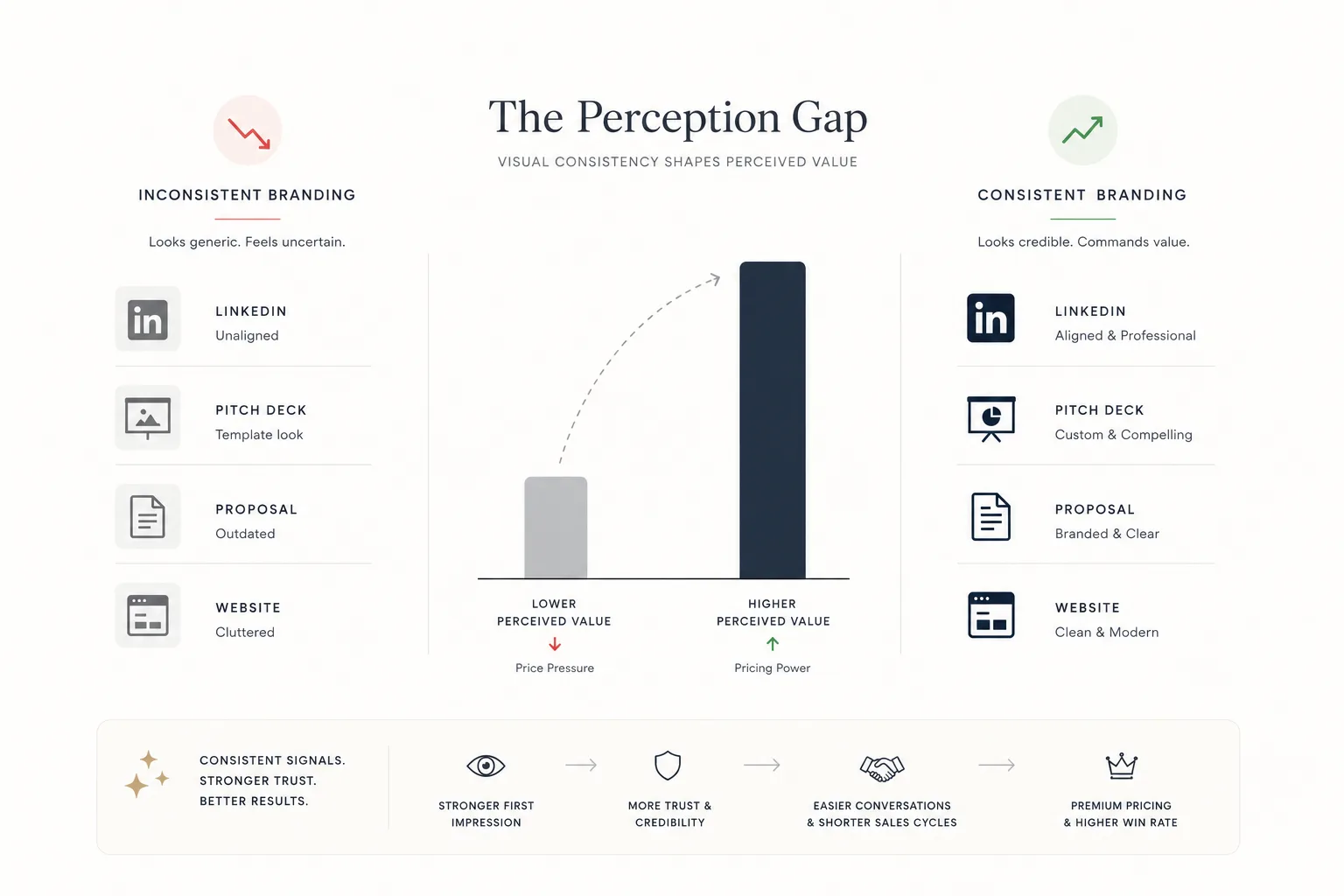
If you suspect your brand is sending the wrong signal, start with the four touchpoints your prospects encounter most often. First, check your LinkedIn company page and personal profile banner. Second, review your pitch deck or capabilities document. Third, look at your proposal template. Finally, examine your website. If any of these four look inconsistent with each other, you have found your gap.
Most growing GTA businesses find the gap in two specific places. The proposal template is the first: many firms last updated it when fees were lower and the business was smaller. Additionally, the LinkedIn profile is the second: it was set up once and never brought to the standard of the other materials. Both are high-stakes touchpoints. The proposal is often the last thing a prospect sees before deciding. LinkedIn is often the first thing they check after a referral. As a result, misalignment at the beginning and end of the client journey creates a particularly damaging brand perception problem.
For a deeper look at why brand inconsistency keeps happening even when you actively try to fix it, this post on the structural causes of an inconsistent brand explains what is actually driving the drift.
What Consistent, Professional Design Actually Does for Your Revenue
When your visual identity matches your expertise level, two things happen. First, your fees become easier to justify — clients associate the quality of your presentation with the quality of your work. Second, your brand builds compounding trust over time. Every touchpoint reinforces the premium signal.
This is why growing businesses and professional services firms in Toronto are moving toward a dedicated monthly design partner. In other words, this investment is not in aesthetics. It is in the revenue that better visual credibility directly enables. This guide to what a monthly design retainer actually includes explains what you get at each scope level and how the numbers compare to your current approach.
Frequently Asked Questions
Does brand perception really affect close rates, or is this theoretical?
It is not theoretical. Consider competitive pitches where two firms of similar capability go head to head. These situations make the visual credibility gap most visible. Specifically, firms with stronger visual consistency win more often. Not because their work is better, but because their materials communicate credibility more effectively. Furthermore, you can test it directly with the audit described above.
Our content is strong. Is design really the priority?
Strong content inside weak packaging underperforms. Above all, it underperforms in the moments that matter most, the first touchpoints where trust is either built or lost. In practice, packaging gets evaluated first. In B2B professional services, buyers use every available signal to assess credibility before committing. Indeed, visual quality is one of the strongest and fastest signals available. The content does not get a fair hearing if the visual presentation has already anchored the prospect's perception at the wrong tier.
How quickly can a dedicated design partner fix this?
Most Pixie Creative clients see a material improvement in their pitch deck and LinkedIn within the first two to three weeks. The full benefit of consistent, compounding visual presence builds over three to six months. If you are not sure whether your business has already hit the point where this makes sense, the five signs your business has outgrown the one-off design model gives you a clear checklist.
Stop looking like the budget option. Book a discovery call with Pixie Creative.
Get in touchPixie Creative is a Toronto-based monthly design partner for GTA professional services firms — including law firms, consulting businesses, and financial services companies. Founded by Maryam, Pixie Creative provides dedicated design support without the freelancer chaos or subscription queue overhead.